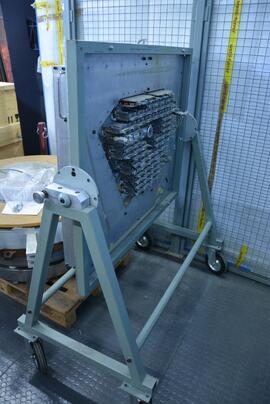
Short section of beampipe from the Large Electron Positron collider (LEP, for short). With its 27-kilometre circumference, LEP was the largest electron-positron accelerator ever built and ran from 1989 to 2000 at CERN. During 11 years of research, LEP's experiments provided a detailed study of the electroweak interaction. Measurements performed at LEP also proved that there are three – and only three – generations of particles of matter. LEP was closed down on 2 November 2000 to make way for the construction of the Large Hadron Collider in the same tunnel.
The pulse of a particle accelerator. 128 of these radio frequency cavities were positioned around CERN's 27-kilometre LEP ring to accelerate electrons and positrons. The acceleration was produced by microwave electric oscillations at 352 MHz. The electrons and positrons were grouped into bunches, like beads on a string, and the copper sphere at the top stored the microwave energy between the passage of individual bunches. This made for valuable energy savings as it reduced the heat generated in the cavity.
RCVD lens n°4
Malcom DykesRCVD lens n°4
Malcom DykesCalculations.Calculations
Schafroth, Max RobertThe items in this collection include rights of the Organization and territorial statutes, agreements and contracts (preparation of the collaboration and cooperation agreements concluded with States, International or National organizations), litigation, insurance, intellectual property (legal advice on technology transfer activities).
Legal Service