Showing 249 results

Archival description
CERN-OBJ-IT-016 · Item · 1983
Part of Heritage Collection

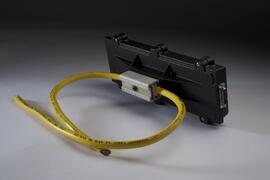
10BASE5 Thick Ethernet Cable, 10Mbit/sec. In the 1980s and early 1990's, Ethernet became more popular and provided a much faster data transmission rate. This cable is one of the first ethernet cables from 1983, a thick, bulky affair. Computers were attached via "Vampire Taps" which were connectors screwed straight through the shielding of the cable.
140Mb 9-track tape
CERN-OBJ-IT-008 · Item · 1965
Part of Heritage Collection

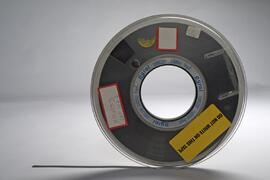
With arrival of CDC 6600 at CERN in January 1965, there came the first half-inch wide 7-tracks tape units with magnetic tapes at recording densities of 200, 556 and 800 bpi (bytes per inch).

2TB hard disk drive
CERN-OBJ-IT-013 · Item
Part of Heritage Collection

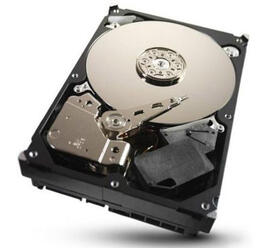
This particular object was used up until 2012 in the Data Centre. It slots into one of the Disk Server trays. Hard disks were invented in the 1950s. They started as large disks up to 20 inches in diameter holding just a few megabytes (link is external). They were originally called "fixed disks" or "Winchesters" (a code name used for a popular IBM product). They later became known as "hard disks" to distinguish them from "floppy disks (link is external)." Hard disks have a hard platter that holds the magnetic medium, as opposed to the flexible plastic film found in tapes and floppies.

CERN-OBJ-IT-059 · Item · 1971
Part of Heritage Collection

It occupies a quad-width, double-height flipchip board you can visually read off its contents (presence or absence of diodes). In its time it represented a giant leap forward since you no longer had to toggle the bootstrap in on the frontpanel switches.

6250 BPI Magnetic Tape
CERN-OBJ-IT-044 · Item
Part of Heritage Collection

These are magnetic coil bands designed by IBM with 6250 BPI. BPI means bits per inch and specifies the data density a magnetic coil can hold.

8-inch IBM floppy disk
CERN-OBJ-IT-037 · Item · 1971
Part of Heritage Collection

The 8-inch floppy disk was a magnetic storage disk for the data introduced commercially by IBM in 1971. It was designed by an IBM team as an inexpensive way to load data into the IBM System / 370. Plus it was a read-only bare disk containing 80 KB of data. The first read-write version was introduced in 1972 by Memorex and could contain 175 KB on 50 tracks (with 8 sectors per track). Other improvements have led to various coatings and increased capacities. Finally, it was surpassed by the mini diskette of 5.25 inches introduced in 1976.

A Diode Matrix model M792
CERN-OBJ-IT-095 · Item
Part of Heritage Collection

A diode matrix is an extremely low-density form of read-only memory. It's one of the earliest forms of ROMs (dating back to the 1950s). Each bit in the ROM is represented by the presence or absence of one diode. The ROM is easily user-writable using a soldering iron and pair of wire cutters.This diode matrix board is a floppy disk boot ROM for a PDP-11, and consists of 32 16-bit words. When you access an address on the ROM, the circuit returns the represented data from that address.