Flash tube used in Gargamelle. Gargamelle was the name given to a big bubble chamber built at the Saclay Laboratory in France during the late 1960s. It was designed principally for the detection at CERN of the elusive particles called neutrinos.Gargamelle is on display at CERN in the Microcosm garden.
About 16 000 Micro Strip Gas Chambers like this one will be used in the CMS tracking detector. They will measure the tracks of charged particles to a hundredth of a millimetre precision in the region near the collision point where the density of particles is very high. Each chamber is filled with a gas mixture of argon and dimethyl ether. Charged particles passing through ionise the gas, knocking out electrons which are collected on the aluminium strips visible under the microscope. Such detectors are being used in radiography. They give higher resolution imaging and reduce the required dose of radiation.
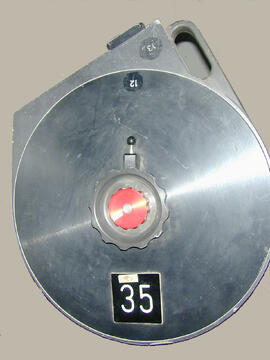
3 bubble chamber film rolls from the 2m bubble chamber.
Wire chamber
The 3.70 metre Big European Bubble Chamber (BEBC) was dismantled on 9 August 1984. One of the biggest detectors in the world, it produced direct visual recording of particle tracks. 6.3 million photos of interactions were taken with the chamber in the course of its existence.
A wire chamber used at CERN's Proton Synchrotron accelerator in the 1970s. Multi-wire detectors contain layers of positively and negatively charged wires enclosed in a chamber full of gas. A charged particle passing through the chamber knocks negatively charged electrons out of atoms in the gas, leaving behind positive ions. The electrons are pulled towards the positively charged wires. They collide with other atoms on the way, producing an avalanche of electrons and ions. The movement of these electrons and ions induces an electric pulse in the wires which is collected by fast electronics. The size of the pulse is proportional to the energy loss of the original particle.
Before the invention of wire chambers, particles tracks were analysed on scanning tables like this one. Today, the process is electronic and much faster. Bubble chamber film - currently available - (links can be found below) was used for this analysis of the particle tracks.
Was used in a PS experiment. Before the days of electronic detectors, visual techniques were used to detect particles, using detectors such as spark chambers and bubble chambers. This plexiglass lens was used to focus the image of tracks so they could be photographed.
Sin títulofor parts