Dipole model slice made in 1994 by Ansaldo. The high magnetic fields needed for guiding particles around the Large Hadron Collider (LHC) ring are created by passing 12’500 amps of current through coils of superconducting wiring. At very low temperatures, superconductors have no electrical resistance and therefore no power loss. The LHC is the largest superconducting installation ever built. The magnetic field must also be extremely uniform. This means the current flowing in the coils has to be very precisely controlled. Indeed, nowhere before has such precision been achieved at such high currents. 50’000 tonnes of steel sheets are used to make the magnet yokes that keep the wiring firmly in place. The yokes constitute approximately 80% of the accelerator's weight and, placed side by side, stretch over 20 km!
Accelerators and storage rings
66 Description archivistique résultats pour Accelerators and storage rings
66 résultats directement liés
Exclure les termes spécifiques
CERN-OBJ-AC-045
·
Pièce
Fait partie de Heritage Collection

CERN-OBJ-AC-050
·
Pièce
Fait partie de Heritage Collection
About NbTi cable: The cable consists of 36 strands of superconducting wire, each strand has a diameter of 0.825 mm and houses 6300 superconducting filaments of niobium-titanium (Nb-Ti, a superconducting alloy). Each filament has a diameter of about 0.006 mm, i.e. 10 times smaller than a typical human hair. The filaments are embedded in a high-purity copper matrix. Copper is a normal conducting material. The filaments are in the superconductive state when the temperature is below about -263ºC (10.15 K). When the filaments leave the superconductive state, the copper acts as conductor transports the electrical current. Each strand of The NbTi cable (at superconducting state) has a current density of up to above 2000 A/mm2 at 9 T and -271ºC (2.15 K). A cable transport a current of about 13000 A at 10 T and -271ºC (2.15 K). About LHC superconducting wiring: The high magnetic fields needed for the LHC can only be reached using superconductors. At very low temperatures, superconductors have no electrical resistance and therefore no power loss. The LHC will be the largest superconducting installation ever built and, at 1.9 degrees above absolute zero (300 degrees below room temperature), one of the the coldest objects in the universe! Magnet coils are made of copper-clad niobium–titanium cables — each wire in the cable consists of 9000 niobium–titanium filaments ten times finer than a hair. The cables carry up to 12 500 amps and must withstand enormous electromagnetic forces. At full field, the force on one metre of magnet is comparable to the weight of a jumbo jet. Coil winding requires great care to prevent movements as the field changes. Friction can create hot spots which “quench” the magnet and ruin its superconductivity. A quench in any of the LHC superconducting magnets would stop machine operation.
CERN-OBJ-AC-067
·
Pièce
Fait partie de Heritage Collection

CERN-OBJ-AC-069
·
Pièce
Fait partie de Heritage Collection
Connection between two superconducting magnets Cryostat - Keeping the magnets cold The Large Hadron Collider superconducting magnets are cooled by liquid helium to 1.9 degrees above absolute zero, or around 300 degrees below the ambient temperature in the tunnel. To keep them cold, each 30 000 kg magnet sits inside a cryostat that isolates it from the tunnel. Inside the cryostat, air is pumped out to reduce heat in-flow. Bellows - Allowing expansion and contraction When the magnets are cooled, they contract: normally 15 metres long, each magnet shrinks by 4.5 cm on its way down to 1.9 degrees above absolute zero. One side of each 30 000 kg magnet is held stationary, while the other is left free to move. Stainless steel bellows such as these absorb the contraction. Notice that every single join needs to allow for such movement, even the electrical connections. Helium Pipe - The cooling supply This pipe carries superfluid helium at 1.9 degrees above absolute zero, around 300 degrees below room temperature. As helium is cooled and put under pressure, it becomes a superfluid, with excellent thermal conductivity, ensuring the temperature is the same everywhere in the circuit. However this gives engineers an extra challenge as superfluids have unusual quantum properties. They can even creep upwards – if there are leaks in the circuit a superfluid will find them! The Large Hadron Collider is cooled by sector, of which there are eight in total. Cool down of one sector takes around 6 weeks. When the accelerator is brought back to room temperature for maintenance works, CERN recuperates the helium and stores it, so it can be reused. Niobium Titanium Cable - Bringing current to the magnets This cable carries the 13 000 amps to the Large Hadron Collider magnets. It is made from a Niobium-Titanium superconductor which is embedded in copper, to ensure an electrical connection is maintained even if the superconductor warms up and stops conducting. This happens at around 10 degrees above absolute zero. The LHC is cooled to 1.9 degrees above absolute zero, to keep the current perfectly stable. Look at the joins in the cable, called splices. They allow the wires to move over each other and retain an electrical connection, when the magnet contracts during cooling. Beam-Pipe Fingers - Keeping the electrical connection Fingers of copper slide over the beam-pipe in every connection between magnets in the Large Hadron Collider. These fingers retain an electrical contact whilst the magnets contract during cooling. The beam-pipe has double layers. The outer layer is slightly colder than the inner one so that any residual gas molecules, left behind in the tube after pumping, are drawn outwards through small holes so they cannot be disturbed by the passing proton beam. Diode - Removing the current There are many mechanisms in place to prevent friction between cable windings that might generate heat and stop the superconductor from conducting. In the eventuality the magnets do stop working, around 13 000 amps of current needs to be taken out of the system. This happens via diodes situated at the extremity of every magnet. The diode conducts a current pulse ramping in less than a second up to 13 000 amps and then slowly decaying down to zero. This process raises their temperature by several hundred degrees, so the diodes are cooled by the LHC Helium circuit.

CERN-OBJ-AC-071
·
Pièce
Fait partie de Heritage Collection
The magnetic field must be extremely uniform. This means the current flowing in the coils has to be very precisely controlled. 50’000 tonnes of steel sheets are used to make the magnet yokes that keep the wiring firmly in place. The yokes constitute approximately 80% of the accelerator's weight and, placed side by side, stretch over 20 km.

CERN-OBJ-AC-073
·
Pièce
Fait partie de Heritage Collection
Each MCS magnet consists of six coils, a laminated iron yoke, an aluminium shrinking cylinder, an end plate that houses the electrical connections and an iron magnetic shield. The coils are made by counter-winding a single, rectangular cross-section, NbTi wire around a G11 central post. The superconductor has a rectangular cross-section and is enamel insulated. The coils are wet wound. After winding G11 end spacers are fitted to the ends of the coils which are then cured. The cured coils are assembled on a precise mandrel together with the connection plate, wrapped with a glass-fibre/epoxy pre-preg bandage and cured to make an MCS coil assembly. The MCS magnet module is built by stacking the eccentric yoke laminations [1] around the MCS coil assembly in 6 different azimuthal orientations and shrink fitting the aluminium shrinking cylinder. The radial interference between the inner diameter of the shrinking cylinder and the outer diameter of the yoke lamination stack is chosen such that the correct pre-stress is produced at operating temperature. This interference is obtained by precise machining of the cured coil assembly outer diameter. Precise dowel holes in the end plate allow accurate placement of the magnet module within the magnetic shield. The magnets are mounted on their support plate in the dipole cold mass by means of a bolted flange, this flange contains a pair of accurately drilled 6H7 holes for doweling to the support plate. Coil inter-connections are made by ultrasonic welding. Quench protection resistors are connected in parallel with each magnet and mounted in the gap between the shrinking cylinder and magnetic shield. [1] A. Ijspeert, J. Salminen, “Superconducting coil compression by scissor laminations”, EPAC-96, Sitges, Spain, June 1996.
CERN-OBJ-AC-074
·
Pièce
Fait partie de Heritage Collection
Dipole Magnet - Guiding the protons around the ring This is a cut-through of the coil of a dipole magnet, that generates the magnetic field used to bend the paths of circulating protons. Looking closely, you can distinguish insulated cables made of individual wires. High and extremely stable magnetic fields are needed for guiding the proton beams, so a superconducting material called Niobium-Titanium was chosen for the wires. At very low temperatures, superconductors have no electrical resistance and therefore no power loss. They carry a very stable current of 13.000 amps, about 20.000 times that used to power this screen. In addition to dipole magnets, the Large Hadron Collider contains quadrupoles and other higher order magnets, used to prepare the proton beams for collision. Dipoles are two pole magnets used for bending the beams of protons around the ring. Quadrupoles have four magnetic poles and are used for focusing the beam, squeezing protons closer together to increase the chance of collision when the beams cross inside the experiments. In total, the LHC uses more than 50 different types of magnet to adjust the particle beams even more finely. The Beam-Pipe - Where the beams of protons circulate Proton beams can circulate for over 10 hours in the Large Hadron Collider. Over this time, protons make four hundred million revolutions of the 27 km machine, traveling a distance equivalent to the diameter of the solar system. They must travel in a pipe that is emptied of air, to avoid collisions with molecules of gas. The beam-pipes are therefore pumped down to an air pressure similar to that on the surface of the moon. There are two pipes, one for each direction of the circulating beams. The two beams only meet inside the four experiments where collisions take place. Liquid Helium - Bringing in the cooling fluid This pipe carries liquid helium through the Large Hadron Collider magnets to keep them at 1.9 degrees above absolute zero - about 300 degrees below room temperature. 800'000 litres of superfluid helium are used to cool down the 36'000 tonnes of equipment. This is the world's biggest cryogenic installation and its reliability and efficiency is essential for the magnets. The pipe connects to the main cryogenic line that you can see running along behind the blue magnets via "jumper connections" like the one to your right. Support Post - Insulating and extremely tough The magnet supports bridge a difference in temperature of nearly 300 degrees! Electrical connections, instrumentation and the posts on which the magnets stand are the only points where heat transfer can happen through conduction. They are all carefully designed to draw off heat progressively. The posts are made of 4 mm thick glass-fibre - epoxy composite material. Each post supports 10'000 kg of magnet and leaks just 0.1 W of heat. There are three per magnet. Magnet Collars - Preventing the wires from moving The LHC accelerates two proton beams moving in opposite directions, so it is really two accelerators in one. To keep the machine as compact and economical as possible, two magnets are built into a single housing that must withstand enormous electromagnetic forces. These forces tend to open-up the coils, and squeeze them. At full field, the force on one metre of coil is comparable to the weight of a jumbo jet. Great care must be taken to prevent movements as the field changes - any friction could create hot spots that would cause the wire to lost its superconducting stage. Magnet collars made from reinforced steel keep the coils firmly in place. Insulation - Preventing heat from leaking In The LHC, beam-tube and magnets are inside a vacuum tank to reduce to a minimum the heat flowing in through convection. To prevent heat inflow through radiation, they are surrounded by a super insulator - multi-layer, reflective, aluminized Mylar. Then to prevent heat flow via conduction, ingenious solutions had to be found for the electrical connections and the support posts. Iron Yoke - Shielding the magnetic field The LHC magnet cables are surrounded by a layered iron yoke that shields the powerful magnetic field - 100'000 times stronger than the Earth's - so that stray fields outside the magnet are negligible. This action also helps enhance the magnetic field within the beam-pipe, where it is needed for control of the proton beams. In addition, the layers of iron yoke, called laminations, play a role together with the magnet collars in keeping cables from moving when the magnet powers up. The technical challenge of manufacturing the laminations centred on ensuring both strength and magnetic homogeneity across a large-scale production. Over 6 million laminations are needed for the 1232 dipole magnets installed around the LHC's 27km ring.
CERN-OBJ-AC-077
·
Pièce
Fait partie de Heritage Collection

CERN-OBJ-AC-078
·
Pièce
Fait partie de Heritage Collection
CERN-OBJ-AC-044
·
Pièce
·
1980
Fait partie de Heritage Collection Test
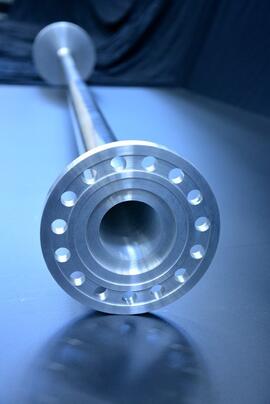
This was the first magnetic horn developed by Simon Van der Meer to collect antiprotons in the AD complex. It was used for the AA (antiproton accumulator). Making an antiproton beam took a lot of time and effort. Firstly, protons were accelerated to an energy of 26 GeV/c (protons at 26GeV/c, antiprotons at 3.6GeV/c) in the PS and ejected onto a metal target. From the spray of emerging particles, a magnetic horn picked out 3.6 GeV antiprotons for injection into the AA through a wide-aperture focusing quadrupole magnet. For a million protons hitting the target, just one antiproton was captured, 'cooled' and accumulated. It took 3 days to make a beam of 3 x 10^11 -, three hundred thousand million - antiprotons. The development of this technology was a key step to the functioning of CERN's Super Proton Synchrotron as a proton - antiproton collider.