Zone d'identification
Cote
Titre
Date(s)
- 1988-01-01 - 1999-12-31 (Création/Production)
Niveau de description
Étendue matérielle et support
5 linear metres
Zone du contexte
Nom du producteur
Notice biographique
Nom du producteur
Notice biographique
Nom du producteur
Notice biographique
Nom du producteur
Notice biographique
Dépôt
Histoire archivistique
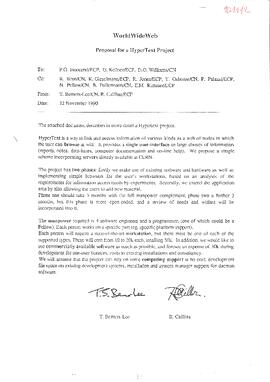
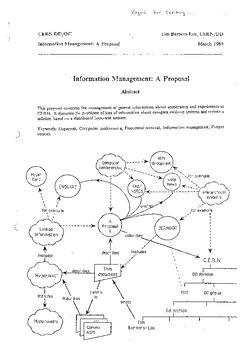
The first proposal for the World Wide Web (WWW) was made at CERN by Tim Berners-Lee in 1989. With the support of his boss Mike Sendall (leader of the Online Computing group in CERN’s Data Handling division from 1985) prototype software for a basic system was ready by the end of the year; it was further refined by Tim Berners-Lee and Robert Cailliau in 1990. The first web servers were all located in European physics laboratories and only a few users had access to the NeXT platform on which the first browser ran. A simpler browser as soon provided, which could be run on any system. In 1991, an early WWW system was released to the high energy physics community via the CERN program library. It included the simple browser, web server software and a library, allowing developers to build their own software. A wide range of universities and research laboratories started to use it, and it was later made generally available via the Internet. The first web server in the United States came on-line in December 1991, at the Stanford Linear Accelerator Center (SLAC) in California. At first there were essentially only two kinds of browser: the original development version (sophisticated but only available on the NeXT machines) and the ‘line-mode’ browser (easy to install and run on any platform but limited in power and user-friendliness). It was clear that the small team at CERN could not do all the work needed to develop the system further, so Tim Berners-Lee launched a plea via the Internet for other developers to join in. Early in 1993, the National Center for Supercomputing Applications (NCSA) at the University of Illinois released a first version of their Mosaic browser, first for the X Window System environment and later also for the PC and Macintosh environments. The existence of reliable user-friendly browsers on these popular computers had an immediate impact on the spread of the WWW. In April 1993 CERN issued a statement putting the Web software in the public domain. By late 1993 there were over 500 known web servers, and the WWW accounted for 1% of Internet traffic. The European Commission approved its first WWW-based project (WISE) at the end of the same year, with CERN as one of the partners. The world’s First International World Wide Web conference was held at CERN in May 1994, attended by 400 users and developers. A second conference, attended by 1300 people, was held in the US in October, organised by the NCSA and the recently created International WWW Conference Committee (IW3C2). By the end of 1994, the Web had 10,000 servers, of which 2,000 were commercial, and 10 million users. An essential point was that the Web should remain an open standard for all to use and that no-one should lock it up into a proprietary system. In this spirit, CERN submitted a proposal to the Commission of the European Union under the ESPRIT programme ‘WebCore’. The goal of the project was an International Consortium, in collaboration with the US Massachusetts Institute of Technology (MIT). Tim Berners-Lee left CERN at the end of 1994 to work on the Consortium from the MIT base. CERN decided that further Web development was an activity beyond its primary mission. The European Commission turned to the French National Institute for Research in Computer Science and Controls (INRIA), to take over the role of CERN. In January 1995, the International World Wide Web Consortium (W3C) was founded ‘to lead the World Wide Web to its full potential by developing common protocols that promote its evolution and ensure its interoperability’.
Source immédiate d'acquisition ou de transfert
Main collection: Robert Cailliau (2001). Additional material: Dan Noyes (from Peter Jurcso; 2013); Ben Segal (2021). James Gillies (2022)
Zone du contenu et de la structure
Portée et contenu
The Web was originally conceived and developed to meet the demand for automatic information sharing between scientists working in different universities and institutes world-wide. It merged the technologies of personal computers, computer networking and hypertext into a powerful and easy to use global information system. The collection covers the period 1988-1999 and includes correspondence, reports, notes, minutes of meetings, administrative documents, and conference and other presentations. It deals with the development of the WWW and efforts to secure support and funding for it.
Évaluation, élimination et calendrier de conservation
Duplicates of magazines, and parts of magazines that were not about the WWW were destroyed.
Accroissements
Additional material may be obtained in connection with the restoration project for the first web site.
Mode de classement
Zone des conditions d'accès et d'utilisation
Conditions d'accès
See file level description and the CERN operational circular No 3: rules applicable to archival material and archiving at CERN. In general, records on any subject that are over 30 years old, and all records of a purely scientific nature, may be consulted.
Conditions de reproduction
Copyright is retained by CERN, no reproduction without permission.
Langue des documents
anglais
français
Écriture des documents
Notes de langue et graphie
Caractéristiques matérielle et contraintes techniques
Instruments de recherche
Zone des sources complémentaires
Existence et lieu de conservation des originaux
Existence et lieu de conservation des copies
Unités de description associées
Zone des notes
Identifiant(s) alternatif(s)
Mots-clés
Mots-clés - Sujets
Mots-clés - Lieux
Mots-clés - Noms
Mots-clés - Genre
Zone du contrôle de la description
Identifiant de la description
Identifiant du service d'archives
Règles et/ou conventions utilisées
Niveau de détail
Dates de production, de révision, de suppression
Langue(s)
Écriture(s)
Sources
Note de l'archiviste
Initial description prepared by Anita Hollier; processing of this collection has not yet been completed. Geneva, August 2011, May 2013. Updated July 2021 & February 2022.