
Zona de identificação
Código de referência
Título
Data(s)
- 2009 (Produção)
Nível de descrição
Dimensão e suporte
Object
Zona do contexto
Entidade detentora
História do arquivo
Fonte imediata de aquisição ou transferência
Zona do conteúdo e estrutura
Âmbito e conteúdo
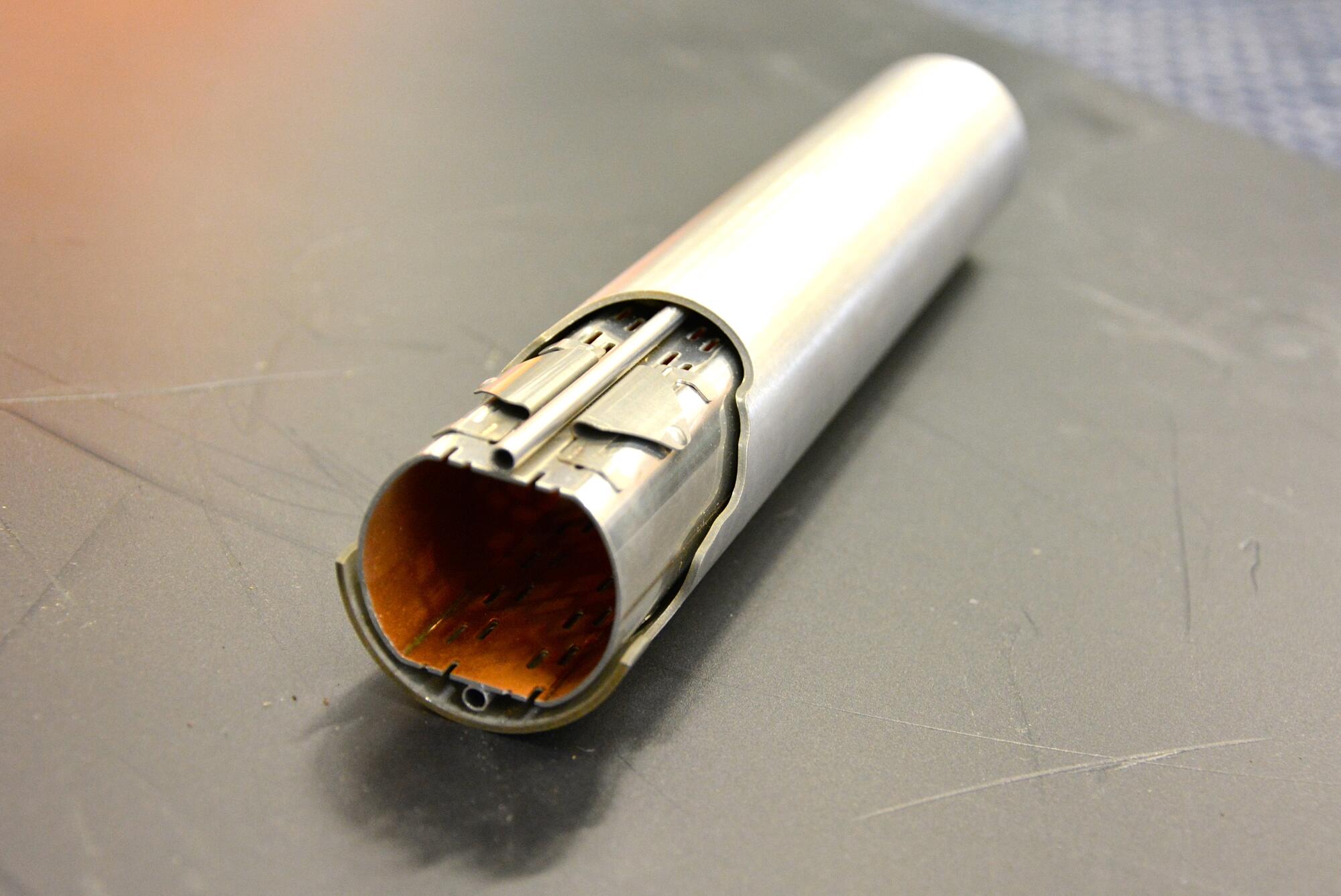
A short section of the LHC beampipe including beam screen. Particle beams circulate for around 10 hours in the Large Hadron Collider (LHC). During this time, the particles make four hundred million revolutions of the machine, travelling a distance equivalent to the diameter of the solar system. The beams must travel in a pipe which is emptied of air, to avoid collisions between the particles and air molecules (which are considerably bigger than protons). The beam pipes are pumped down to an air pressure similar to that on the surface of the moon. Emptying the air from the two 27 km long Large Hadron Collider beam-pipes is equivalent in volume to emptying the nave of the Notre Dame cathedral in Paris. Initially, the air pressure is reduced by pumping. Then, cold sections of the beam-pipe are further emptied using the temperature gradient across special beam-screens inside the tube where particles travel. The warm sections are emptied using a coating called a getter that works like molecular fly-paper. This vacuum technology has applications in high performance solar panels. More technical information: In the LHC, particles circulate under vacuum. The vacuum chamber can be at room temperature (for example, in the experimental areas), or at cryogenic temperature, in the superconductive magnets. This piece is located in the superconductive magnets. The outer pipe is the vacuum chamber, which is in contact with the magnets, at cryogenic temperature (1.9K). It is called the “cold bore”. The inner tube is the beam screen. Its main goal is to protect the magnets from the heat load coming from the synchrotron radiation. Indeed, when high energy protons’ trajectory is bent, photons are emitted by the beam. They are intercepted by the beam screen. The temperature of the beam screen is kept between 5 and 20K by a circulation of gaseous helium in the small pipes on both sides of the beam screen. As those surfaces are at cryogenic temperature. The residual gas present in the accelerator is sticking on the surfaces. This phenomenon called “adsorption” is used to maintain a very low pressure in the vacuum chamber of the accelerator. About materials: The cold bore is in stainless steel. The beam screen is in stainless steel with colaminated copper. Both those material have a low outgassing rates, which means that they release few molecules in the vacuum chamber. About beam and impedance: The goal of the copper, which has a good electrical conductivity, is to facilitate the circulation of the image current. The beam is composed of charged particules circulating: it is an electric current. When it is circulating, an image current is produced. It is called induction. If the image current cannot circulate properly, the beam is slowed down. About adsorption process: When the beam circulates, photons from synchrotron radiation are emitted and hit the beam screen. By doing so, they desorb molecules from the walls. The molecules are then pumped down on the outer pipe (where they cannot be reached by the photons anymore), through the small holes in the beam screen.
Avaliação, seleção e eliminação
Incorporações
Sistema de arranjo
Zona de condições de acesso e utilização
Condições de acesso
Public
Condiçoes de reprodução
Idioma do material
Sistema de escrita do material
Notas ao idioma e script
Características físicas e requisitos técnicos
500 CHF
Instrumentos de descrição
Zona de documentação associada
Existência e localização de originais
On loan, b. 282 - Reserved for Science Gateway.
Existência e localização de cópias
Unidades de descrição relacionadas
Zona das notas
Identificador(es) alternativo(s)
CDS number
Pontos de acesso
Pontos de acesso - Assuntos
Pontos de acesso - Locais
Pontos de acesso - Nomes
Pontos de acesso de género
Zona do controlo da descrição
Identificador da descrição
Identificador da instituição
Regras ou convenções utilizadas
Nível de detalhe
Datas de criação, revisão, eliminação
Línguas e escritas
Script(s)
Fontes
Nota do arquivista
01/02/2019 Reserved for Science Gateway Rolf Landua, CERN exhibition IR-ECO and the Automnales exhibition (10-19/11) Bahrain, February - September 2019
