
Identificatie
referentie code
Titel
Datum(s)
- 2009 (Vervaardig)
Beschrijvingsniveau
Omvang en medium
Object
Context
archiefbewaarplaats
Geschiedenis van het archief
Directe bron van verwerving of overbrenging
Inhoud en structuur
Bereik en inhoud
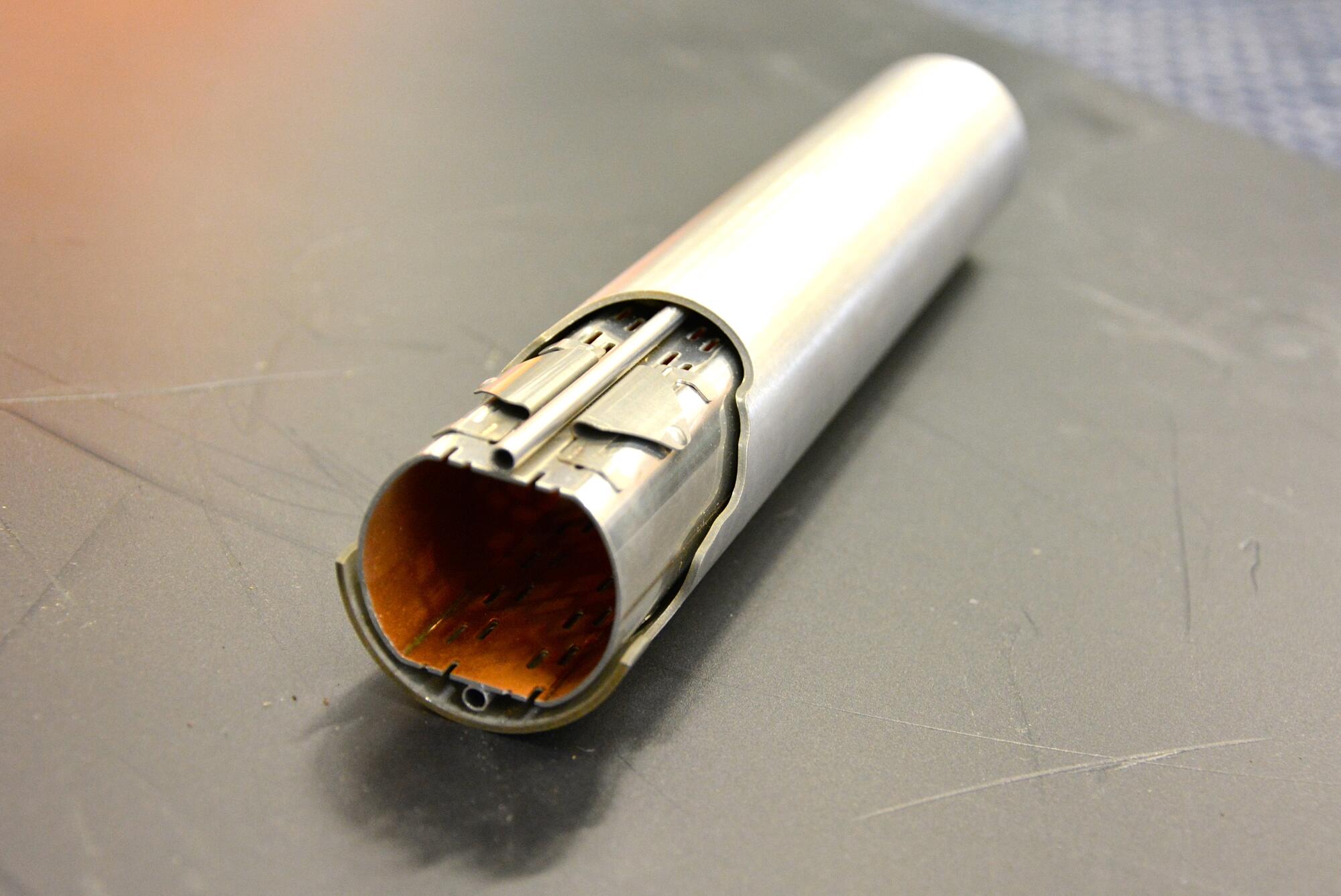
A short section of the LHC beampipe including beam screen. Particle beams circulate for around 10 hours in the Large Hadron Collider (LHC). During this time, the particles make four hundred million revolutions of the machine, travelling a distance equivalent to the diameter of the solar system. The beams must travel in a pipe which is emptied of air, to avoid collisions between the particles and air molecules (which are considerably bigger than protons). The beam pipes are pumped down to an air pressure similar to that on the surface of the moon. Emptying the air from the two 27 km long Large Hadron Collider beam-pipes is equivalent in volume to emptying the nave of the Notre Dame cathedral in Paris. Initially, the air pressure is reduced by pumping. Then, cold sections of the beam-pipe are further emptied using the temperature gradient across special beam-screens inside the tube where particles travel. The warm sections are emptied using a coating called a getter that works like molecular fly-paper. This vacuum technology has applications in high performance solar panels. More technical information: In the LHC, particles circulate under vacuum. The vacuum chamber can be at room temperature (for example, in the experimental areas), or at cryogenic temperature, in the superconductive magnets. This piece is located in the superconductive magnets. The outer pipe is the vacuum chamber, which is in contact with the magnets, at cryogenic temperature (1.9K). It is called the “cold bore”. The inner tube is the beam screen. Its main goal is to protect the magnets from the heat load coming from the synchrotron radiation. Indeed, when high energy protons’ trajectory is bent, photons are emitted by the beam. They are intercepted by the beam screen. The temperature of the beam screen is kept between 5 and 20K by a circulation of gaseous helium in the small pipes on both sides of the beam screen. As those surfaces are at cryogenic temperature. The residual gas present in the accelerator is sticking on the surfaces. This phenomenon called “adsorption” is used to maintain a very low pressure in the vacuum chamber of the accelerator. About materials: The cold bore is in stainless steel. The beam screen is in stainless steel with colaminated copper. Both those material have a low outgassing rates, which means that they release few molecules in the vacuum chamber. About beam and impedance: The goal of the copper, which has a good electrical conductivity, is to facilitate the circulation of the image current. The beam is composed of charged particules circulating: it is an electric current. When it is circulating, an image current is produced. It is called induction. If the image current cannot circulate properly, the beam is slowed down. About adsorption process: When the beam circulates, photons from synchrotron radiation are emitted and hit the beam screen. By doing so, they desorb molecules from the walls. The molecules are then pumped down on the outer pipe (where they cannot be reached by the photons anymore), through the small holes in the beam screen.
Waardering, vernietiging en slectie
Aanvullingen
Ordeningstelsel
Voorwaarden voor toegang en gebruik
Voorwaarden voor raadpleging
Public
Voorwaarden voor reproductie
Taal van het materiaal
Schrift van het materiaal
Taal en schrift aantekeningen
Fysieke eigenschappen en technische eisen
500 CHF
Toegangen
Verwante materialen
Bestaan en verblifplaats van originelen
On loan, b. 282 - Reserved for Science Gateway.
Bestaan en verblijfplaats van kopieën
Related units of description
Aantekeningen
Alternative identifier(s)
CDS number
Trefwoorden
Onderwerp trefwoord
Geografische trefwoorden
Naam ontsluitingsterm
Genre access points
Beschrijvingsbeheer
Identificatie van de beschrijving
Identificatiecode van de instelling
Toegepaste regels en/of conventies
Niveau van detaillering
Verwijdering van datering archiefvorming
Taal (talen)
Schrift(en)
Bronnen
Aantekeningen van de archivaris
01/02/2019 Reserved for Science Gateway Rolf Landua, CERN exhibition IR-ECO and the Automnales exhibition (10-19/11) Bahrain, February - September 2019
