
Zona de identificação
Código de referência
Título
Data(s)
- 1995 (Produção)
Nível de descrição
Dimensão e suporte
Object
Zona do contexto
Nome do produtor
História biográfica
Entidade detentora
História do arquivo
Fonte imediata de aquisição ou transferência
Zona do conteúdo e estrutura
Âmbito e conteúdo
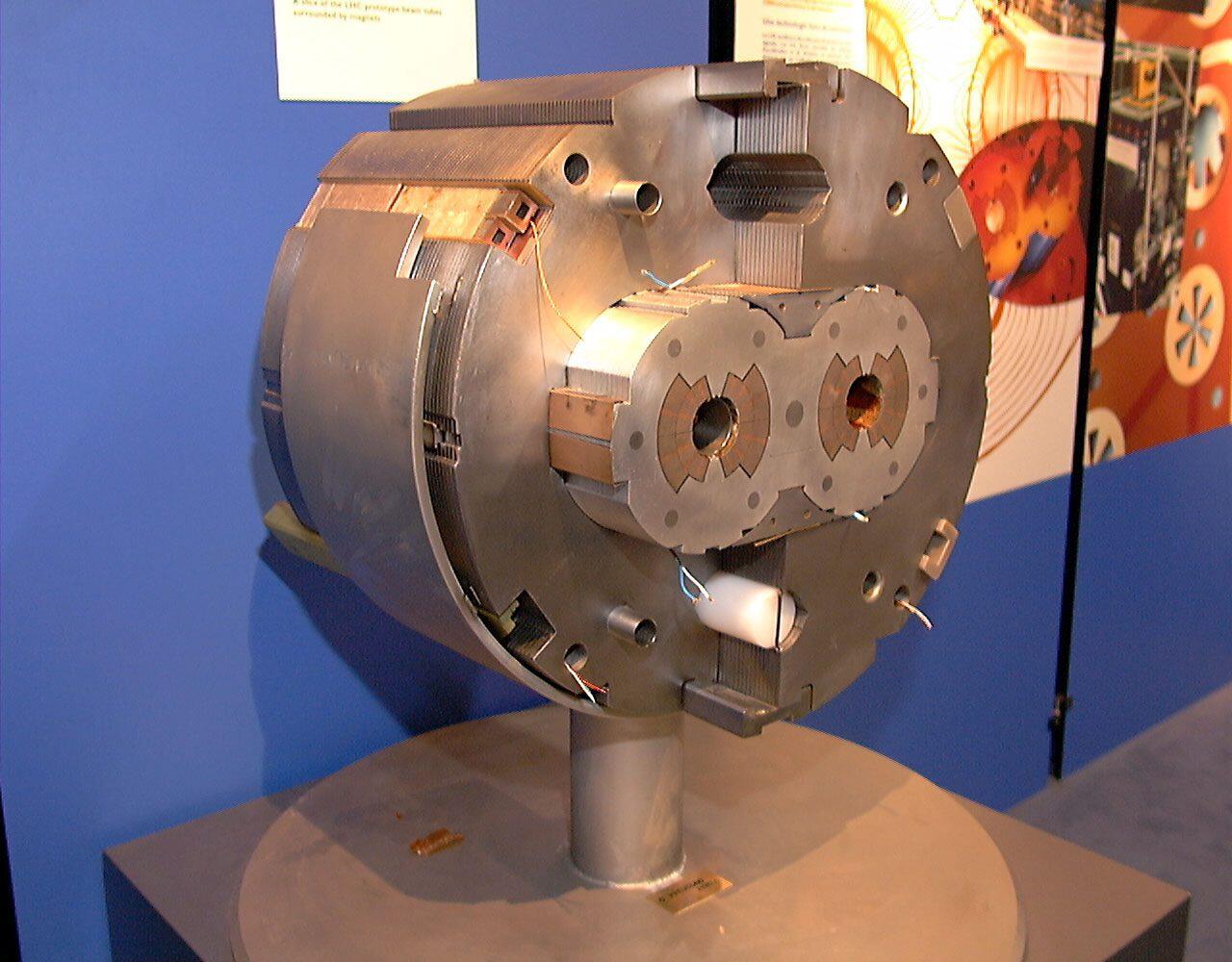
Slice of the Large Hadron Collider (LHC) prototype beam tubes in dipole magnet The LHC is the world’s largest and most powerful particle accelerator that accelerates and collides two beams of protons or ions to near the speed of light in opposite directions. It first started up in 2008, and is the latest addition to CERN’s accelerator complex (2025). The LHC consists of a 27-km ring of superconducting magnets with a number of accelerating structures to boost the energy of the particles along the way. Thousands of magnets of different varieties and sizes are used to direct the beams around the accelerator. The high bending and accelerating fields needed can only be reached using superconductor magnets at very low temperature (‑271.3°C). There are 1232 dipole magnets like this prototype in the LHC, used to guide the particles around the 27 km ring. Dipole magnets must have an extremely uniform field, which means the current flowing in the coils that produce the magnetic field has to be very precisely controlled. Nowhere before has such precision been achieved at such high currents. The temperature is measured to five thousandths of a degree, the current to one part in a million. The current creating the magnetic field pass through superconducting wires at up to 12 500 amps, about 30 000 times the current flowing in a 100 W light bulb. Since the LHC accelerate two particle beams moving in opposite directions, it is really two accelerators in one. To keep the machine as compact and economical as possible, two dipole magnets are built into a single housing.
Avaliação, seleção e eliminação
Incorporações
Sistema de arranjo
Zona de condições de acesso e utilização
Condições de acesso
Public
Condiçoes de reprodução
Idioma do material
Sistema de escrita do material
Notas ao idioma e script
Características físicas e requisitos técnicos
60cm 80 45cm 964kg
Instrumentos de descrição
Zona de documentação associada
Existência e localização de originais
On loan, SM18.
Existência e localização de cópias
Unidades de descrição relacionadas
Zona das notas
Nota
A <2> pages publication from CERN for general public
Identificador(es) alternativo(s)
CDS number
Object Number
Pontos de acesso
Pontos de acesso - Assuntos
Pontos de acesso - Locais
Pontos de acesso - Nomes
Pontos de acesso de género
Zona do controlo da descrição
Identificador da descrição
Identificador da instituição
Regras ou convenções utilizadas
Nível de detalhe
Datas de criação, revisão, eliminação
Línguas e escritas
Script(s)
Fontes
Nota do arquivista
SM18
