
Identificatie
referentie code
Titel
Datum(s)
- 1995 (Vervaardig)
Beschrijvingsniveau
Omvang en medium
Object
Context
Naam van de archiefvormer
Biografie
archiefbewaarplaats
Geschiedenis van het archief
Directe bron van verwerving of overbrenging
Inhoud en structuur
Bereik en inhoud
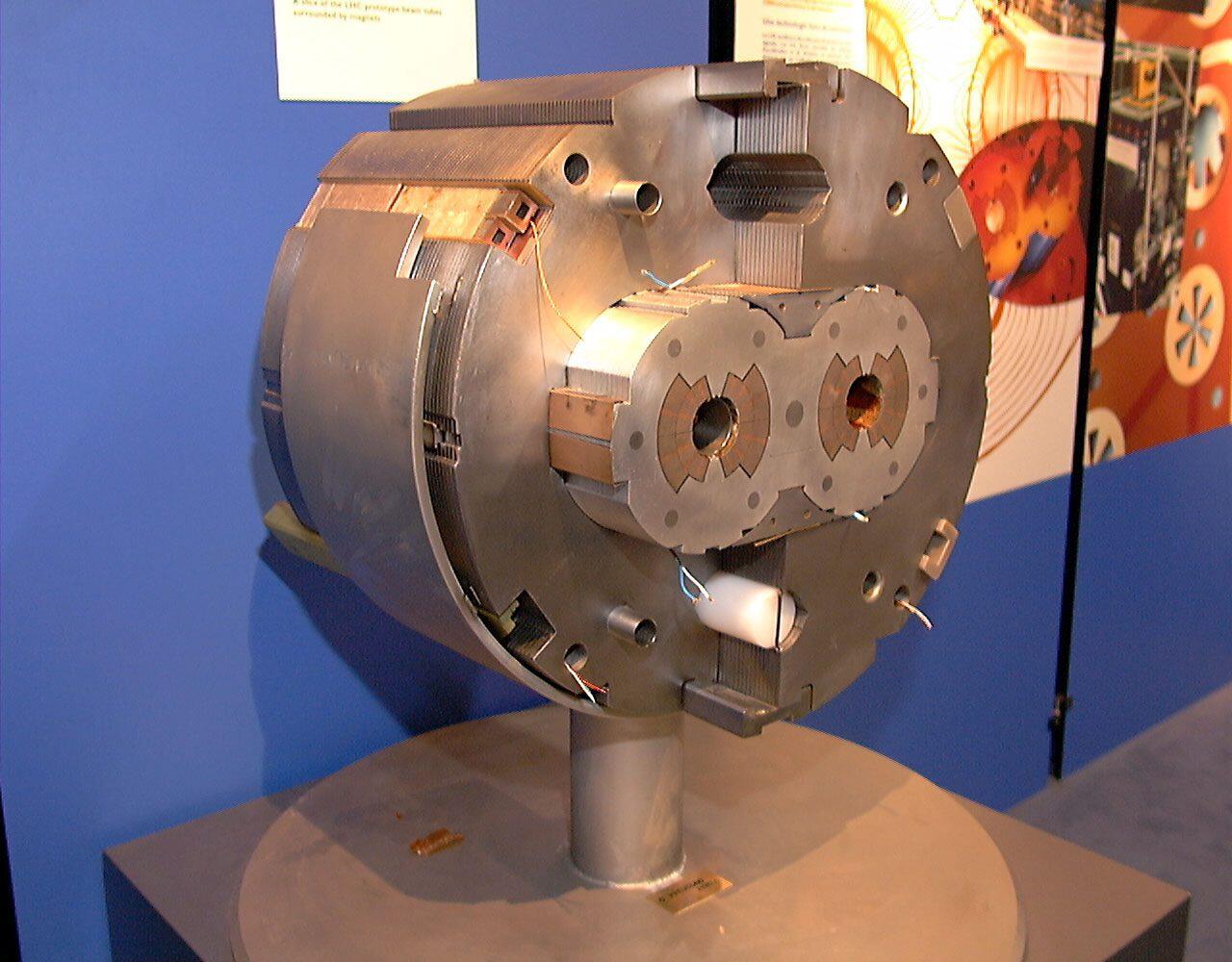
Slice of the Large Hadron Collider (LHC) prototype beam tubes in dipole magnet The LHC is the world’s largest and most powerful particle accelerator that accelerates and collides two beams of protons or ions to near the speed of light in opposite directions. It first started up in 2008, and is the latest addition to CERN’s accelerator complex (2025). The LHC consists of a 27-km ring of superconducting magnets with a number of accelerating structures to boost the energy of the particles along the way. Thousands of magnets of different varieties and sizes are used to direct the beams around the accelerator. The high bending and accelerating fields needed can only be reached using superconductor magnets at very low temperature (‑271.3°C). There are 1232 dipole magnets like this prototype in the LHC, used to guide the particles around the 27 km ring. Dipole magnets must have an extremely uniform field, which means the current flowing in the coils that produce the magnetic field has to be very precisely controlled. Nowhere before has such precision been achieved at such high currents. The temperature is measured to five thousandths of a degree, the current to one part in a million. The current creating the magnetic field pass through superconducting wires at up to 12 500 amps, about 30 000 times the current flowing in a 100 W light bulb. Since the LHC accelerate two particle beams moving in opposite directions, it is really two accelerators in one. To keep the machine as compact and economical as possible, two dipole magnets are built into a single housing.
Waardering, vernietiging en slectie
Aanvullingen
Ordeningstelsel
Voorwaarden voor toegang en gebruik
Voorwaarden voor raadpleging
Public
Voorwaarden voor reproductie
Taal van het materiaal
Schrift van het materiaal
Taal en schrift aantekeningen
Fysieke eigenschappen en technische eisen
60cm 80 45cm 964kg
Toegangen
Verwante materialen
Bestaan en verblifplaats van originelen
On loan, SM18.
Bestaan en verblijfplaats van kopieën
Related units of description
Aantekeningen
Aantekening
A <2> pages publication from CERN for general public
Alternative identifier(s)
CDS number
Object Number
Trefwoorden
Onderwerp trefwoord
Geografische trefwoorden
Naam ontsluitingsterm
Genre access points
Beschrijvingsbeheer
Identificatie van de beschrijving
Identificatiecode van de instelling
Toegepaste regels en/of conventies
Niveau van detaillering
Verwijdering van datering archiefvorming
Taal (talen)
Schrift(en)
Bronnen
Aantekeningen van de archivaris
SM18
