The first layer of the ATLAS detector’s calorimeter is made of 8’200 lead plates and electrodes folded into an accordion shape and immersed in liquid argon. ATLAS (A Toroidal LHC ApparatuS) is the largest, general-purpose particle detector experiment at the Large Hadron Collider (LHC). As particles cross the folds and interact with the lead atoms, electrons and photons are ejected. There is a knock-on effect and as they continue on into the argon, a whole shower of secondary particles is produced. The electrodes register a signal that gives a measurement of the energy of the initial particle. As with most of the LHC detectors, the structural design challenge is to hold the heavy elements in place without affecting the measurements of the particles. Here, the layers of honeycomb spacer are designed to do just that. They separate the copper electrode layer from the lead and stainless steel absorber, allowing the liquid argon to flow freely in between.
The discovery of the Higgs boson by the ATLAS and CMS experiments was announced in CERN’s main auditorium in July 2012. Here, finally, was the missing piece in the standard model describing our universe. For some, it was the culmination of over 40 years’ work. This champagne bottle was drunk by members of CERN’s Theoretical physics group on the occasion.
An alternative method of detecting particles spraying out of collisions in the inner regions of experiments uses scintillating fibres.
A beautiful module of tracker from the CMS experiment, made up of silicon.
The Gas Electron Multiplier (GEM) is a state-of-the-art particle detection technology utilized in the CMS experiment at CERN. It enhances the accuracy and resolution of muon measurements, playing a pivotal role in advancing our understanding of fundamental particle physics.
Part of the IBM computer that was used for physics simulations in preparation for experiments at LEP. When installed in 1985, it was considered to be very powerful. Nowadays, a PC can outperform it by a factor of ten.
Mostly used with scanning tables to record data coded on 6 holes.
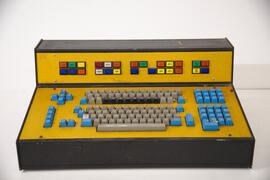
Special terminals for the first computer ever used by CERN library.
Oracle StorageTek T10000T2 cartridge has total capacity of 5 TB. It is actually manufactured by Fuji Film, uses Barium Ferrite (BaFe) particles technology data store, but is also equipped with RFID chip. There is over 1 km of tape inside of the cartridge with 3584 data tracks and it supports over 25000 load/unload cycles. The archival life is estimated to be around 30 years and uncorrected bit error rate is 10-19. CERN however usually migrates data to newer technologies roughly every 5 years in order to keep the footprint under control.