This model was a disk storage server used in the Data Centre up until 2012. Each tray contains a hard disk drive (see the 5TB hard disk drive on the main disk display section - this actually fits into one of the trays). There are 16 trays in all per server. There are hundreds of these servers mounted on racks in the Data Centre, as can be seen.
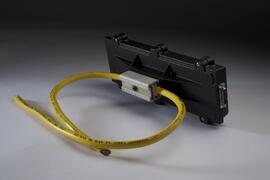
10BASE5 Thick Ethernet Cable, 10Mbit/sec. In the 1980s and early 1990's, Ethernet became more popular and provided a much faster data transmission rate. This cable is one of the first ethernet cables from 1983, a thick, bulky affair. Computers were attached via "Vampire Taps" which were connectors screwed straight through the shielding of the cable.
The first website at CERN - and in the world - was dedicated to the World Wide Web project itself and was hosted on Berners-Lee's NeXT computer. The website described the basic features of the web; how to access other people's documents and how to set up your own server. This NeXT machine - the original web server - is still at CERN. As part of the project to restore the first website, in 2013 CERN reinstated the world's first website to its original address.
The CDC 7600 has been created by Seymour Cray. It was designed to be compatible with the 6600, which allows for a substantial increase in performance. Furthermore the rise of new technologies has enabled this performance by reducing the minor cycle clock period from 100 ns to 27.5 ns (4 time faster). A very large machine, the 7600 had over 120 miles of hand-wired interconnections. It was the most powerful computer of its time. However, this speed caused a ground-loop problem causing intermittent faults, and eventually requiring all modules to be fitted with sheathed rubber bands. The CDC 7600 was replaced in 1983 by CRAY-1A.
The CDC 6600 cordwood module containing 64 silicon transistors. The module was mounted between two plates that were cooled conductive by a refrigeration unit via the front panel. The construction of this module uses the cord method, so called because the resistors seem to be stacked like cord between the two circuit boards in order to obtain a high density. The 6600 model contained nearly 6,000 such modules.
It was essentially a folded sheet metal box with an internal circuit board, but Gandalf Box was a form of modem, a terminal host selector that allowed computer terminals to connect to a number of computers, Host computers via a single interface. Gandalf Technologies was a Canadian data communications company based in Ottawa. It was best known for their modems and terminal adapters. The rapid development of ethernet, remote access and subsequent high-speed connections killed technology and the company went bankrupt in 1997.
The Olivetti M10 is a small Italian computer, it is a first attempt to create a real laptop with its screen tilting offering a good legibility. Its success was mainly due to the good quality keyboard with its accented keys that allows a fast typing as well as has its long battery life. It can operate several hours on four standard batteries. Otherwise, in terms of software, the machine has Basic in ROM, as well as various small office programs such as spreadsheet, word processor, calendar and address book.
The DEC (Digital Equipment Corporation) VT220 is a text terminal which uses an redesigned keyboard(LK201). The VT220 improved on the earlier VT100 series of terminals with much smaller physical packaging and and a much faster microprocessor.
This is a LCD Screen with a 1280x1024 resolution.
The 8-inch floppy disk was a magnetic storage disk for the data introduced commercially by IBM in 1971. It was designed by an IBM team as an inexpensive way to load data into the IBM System / 370. Plus it was a read-only bare disk containing 80 KB of data. The first read-write version was introduced in 1972 by Memorex and could contain 175 KB on 50 tracks (with 8 sectors per track). Other improvements have led to various coatings and increased capacities. Finally, it was surpassed by the mini diskette of 5.25 inches introduced in 1976.