A short section of the LHC beampipe including beam screen. Particle beams circulate for around 10 hours in the Large Hadron Collider (LHC). During this time, the particles make four hundred million revolutions of the machine, travelling a distance equivalent to the diameter of the solar system. The beams must travel in a pipe which is emptied of air, to avoid collisions between the particles and air molecules (which are considerably bigger than protons). The beam pipes are pumped down to an air pressure similar to that on the surface of the moon. Emptying the air from the two 27 km long Large Hadron Collider beam-pipes is equivalent in volume to emptying the nave of the Notre Dame cathedral in Paris. Initially, the air pressure is reduced by pumping. Then, cold sections of the beam-pipe are further emptied using the temperature gradient across special beam-screens inside the tube where particles travel. The warm sections are emptied using a coating called a getter that works like molecular fly-paper. This vacuum technology has applications in high performance solar panels. More technical information: In the LHC, particles circulate under vacuum. The vacuum chamber can be at room temperature (for example, in the experimental areas), or at cryogenic temperature, in the superconductive magnets. This piece is located in the superconductive magnets. The outer pipe is the vacuum chamber, which is in contact with the magnets, at cryogenic temperature (1.9K). It is called the “cold bore”. The inner tube is the beam screen. Its main goal is to protect the magnets from the heat load coming from the synchrotron radiation. Indeed, when high energy protons’ trajectory is bent, photons are emitted by the beam. They are intercepted by the beam screen. The temperature of the beam screen is kept between 5 and 20K by a circulation of gaseous helium in the small pipes on both sides of the beam screen. As those surfaces are at cryogenic temperature. The residual gas present in the accelerator is sticking on the surfaces. This phenomenon called “adsorption” is used to maintain a very low pressure in the vacuum chamber of the accelerator. About materials: The cold bore is in stainless steel. The beam screen is in stainless steel with colaminated copper. Both those material have a low outgassing rates, which means that they release few molecules in the vacuum chamber. About beam and impedance: The goal of the copper, which has a good electrical conductivity, is to facilitate the circulation of the image current. The beam is composed of charged particules circulating: it is an electric current. When it is circulating, an image current is produced. It is called induction. If the image current cannot circulate properly, the beam is slowed down. About adsorption process: When the beam circulates, photons from synchrotron radiation are emitted and hit the beam screen. By doing so, they desorb molecules from the walls. The molecules are then pumped down on the outer pipe (where they cannot be reached by the photons anymore), through the small holes in the beam screen.

Slice through an LHC superconducting quadrupole (focusing) magnet. The slice includes a cut through the magnet wiring (niobium titanium), the beampipe and the steel magnet yokes. Particle beams in the Large Hadron Collider (LHC) have the same energy as a high-speed train, squeezed ready for collision into a space narrower than a human hair. Huge forces are needed to control them. Dipole magnets (2 poles) are used to bend the paths of the protons around the 27 km ring. Quadrupole magnets (4 poles) focus the proton beams and squeeze them so that more particles collide when the beams’ paths cross. Bringing beams into collision requires a precision comparable to making two knitting needles collide, launched from either side of the Atlantic Ocean.
Dipole model slice made in 1994 by Ansaldo. The high magnetic fields needed for guiding particles around the Large Hadron Collider (LHC) ring are created by passing 12’500 amps of current through coils of superconducting wiring. At very low temperatures, superconductors have no electrical resistance and therefore no power loss. The LHC is the largest superconducting installation ever built. The magnetic field must also be extremely uniform. This means the current flowing in the coils has to be very precisely controlled. Indeed, nowhere before has such precision been achieved at such high currents. 50’000 tonnes of steel sheets are used to make the magnet yokes that keep the wiring firmly in place. The yokes constitute approximately 80% of the accelerator's weight and, placed side by side, stretch over 20 km!

About NbTi cable: The cable consists of 36 strands of superconducting wire, each strand has a diameter of 0.825 mm and houses 6300 superconducting filaments of niobium-titanium (Nb-Ti, a superconducting alloy). Each filament has a diameter of about 0.006 mm, i.e. 10 times smaller than a typical human hair. The filaments are embedded in a high-purity copper matrix. Copper is a normal conducting material. The filaments are in the superconductive state when the temperature is below about -263ºC (10.15 K). When the filaments leave the superconductive state, the copper acts as conductor transports the electrical current. Each strand of The NbTi cable (at superconducting state) has a current density of up to above 2000 A/mm2 at 9 T and -271ºC (2.15 K). A cable transport a current of about 13000 A at 10 T and -271ºC (2.15 K). About LHC superconducting wiring: The high magnetic fields needed for the LHC can only be reached using superconductors. At very low temperatures, superconductors have no electrical resistance and therefore no power loss. The LHC will be the largest superconducting installation ever built and, at 1.9 degrees above absolute zero (300 degrees below room temperature), one of the the coldest objects in the universe! Magnet coils are made of copper-clad niobium–titanium cables — each wire in the cable consists of 9000 niobium–titanium filaments ten times finer than a hair. The cables carry up to 12 500 amps and must withstand enormous electromagnetic forces. At full field, the force on one metre of magnet is comparable to the weight of a jumbo jet. Coil winding requires great care to prevent movements as the field changes. Friction can create hot spots which “quench” the magnet and ruin its superconductivity. A quench in any of the LHC superconducting magnets would stop machine operation.

Part of the IBM computer that was used for physics simulations in preparation for experiments at LEP. When installed in 1985, it was considered to be very powerful. Nowadays, a PC can outperform it by a factor of ten.

Mostly used with scanning tables to record data coded on 6 holes.

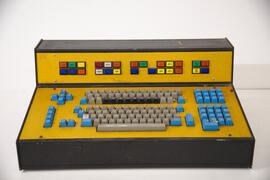
Special terminals for the first computer ever used by CERN library.
Oracle StorageTek T10000T2 cartridge has total capacity of 5 TB. It is actually manufactured by Fuji Film, uses Barium Ferrite (BaFe) particles technology data store, but is also equipped with RFID chip. There is over 1 km of tape inside of the cartridge with 3584 data tracks and it supports over 25000 load/unload cycles. The archival life is estimated to be around 30 years and uncorrected bit error rate is 10-19. CERN however usually migrates data to newer technologies roughly every 5 years in order to keep the footprint under control.
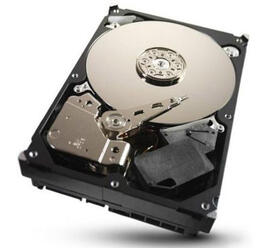
This particular object was used up until 2012 in the Data Centre. It slots into one of the Disk Server trays. Hard disks were invented in the 1950s. They started as large disks up to 20 inches in diameter holding just a few megabytes (link is external). They were originally called "fixed disks" or "Winchesters" (a code name used for a popular IBM product). They later became known as "hard disks" to distinguish them from "floppy disks (link is external)." Hard disks have a hard platter that holds the magnetic medium, as opposed to the flexible plastic film found in tapes and floppies.