This valve was used in the Intersecting Storage Rings (ISR) to protect against the shock waves that would be caused if air were to enter the vacuum tube. Some of the ISR chambers were very fragile, with very thin walls - a design required by physicists on the lookout for new particles.
This magnetic focusing horn was used for the AA (antiproton accumulator). Its development was an important step towards using CERN's Super Proton Synchrotron as a proton - antiproton collider. This eventually led to the discovery of the W and Z particles in 1983. Making an antiproton beam took a lot of time and effort. Firstly, protons were accelerated to an energy of 26 GeV in the PS and ejected onto a metal target. From the spray of emerging particles, a magnetic horn picked out 3.6 GeV antiprotons for injection into the AA through a wide-aperture focusing quadrupole magnet. For a million protons hitting the target, just one antiproton was captured, 'cooled' and accumulated. It took 3 days to make a beam of 3 x 10^11 -, three hundred thousand million - antiprotons.
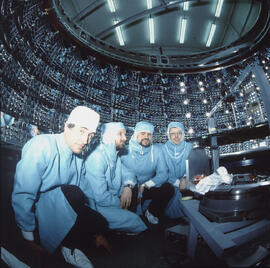
DELPHI was one of the four experiments installed at the LEP particle accelerator from 1989 - 2000. This is a piece of the Barrel Ring Imaging Cherenkov detector which was used to identify particles in DELPHI.It measured the Cherenkov light emitted when particles travelled faster than the speed of light through the material of the detector. The photo shows the complete Cherenkov detector.
OPAL was one of the four experiments installed at the LEP particle accelerator from 1989 - 2000. The Silicon Tungsten Luminometer was part of OPAL's calorimeter which was used to measure the energy of particles. Most particles end their journey in calorimeters. These detectors measure the energy deposited when particles are slowed down and stopped.
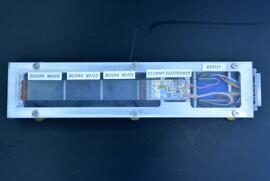
The module was used as part of the muon identification system on the barrel of the DELPHI detector at LEP, and was in active use from 1989 to 2000. The module consists of 7 individual muons chambers arranged in 2 layers. Chambers in the upper layer are staggered by half a chamber width with respect to the lower layer. Each individual chamber is a drift chamber consisting of an anode wire, 47 microns in diameter, and a wrapped copper delay line. Each chamber provided 3 signal for each muon passing through the chamber, from which a 3D space-point could be reconstructed.
Sin títuloOPAL was one of the 4 experiments installed at the LEP particle accelerator from 1989 to 2000. This is a slice of the outermost layer of OPAL : the muon chambers. This outside layer detects particles which are not stopped by the previous layers. These are mostly muons.
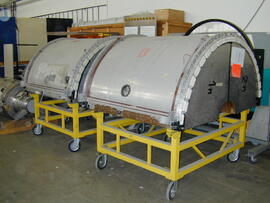
Two wire chambers made originally for the R807 Experiment at CERN's Intersecting Storage Rings. In 1986 they were used for the PS 201 experiment (Obelix Experiment) at LEAR, the Low Energy Antiproton Ring. The group of researchers from Turin, using the chambers at that time, changed the acquisition system using for the first time 8 bit (10 bit non linear) analog to digital conversion for incoming signals from the chambers. The acquisition system was controlled by 54 CPU and 80 digital signal processors. The power required for all the electronics was 40 kW. For the period, this system was one of the most powerful on-line apparatus in the world. The Obelix Experiment was closed in 1996. To find more about how a wire chamber works, see the description for object CERN-OBJ-DE-038.
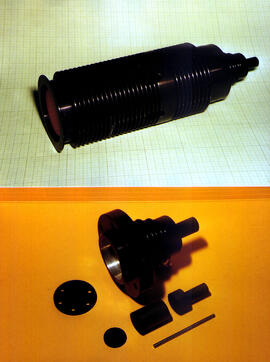
<!--HTML-->Antiproton target used for the AA (antiproton accumulator). The first type of antiproton production target used from 1980 to 1982 comprised a rod of copper 3mm diameter and 120mm long embedded in a graphite cylinder that was itself pressed into a finned aluminium container. This assembly was air-cooled and it was used in conjunction with the Van der Meer magnetic horn. In 1983 Fermilab provided us with lithium lenses to replace the horn with a view to increasing the antiproton yield by about 30%. These lenses needed a much shorter target made of heavy metal - iridium was chosen for this purpose. The 50 mm iridium rod was housed in an extension to the original finned target container so that it could be brought very close to the entrance to the lithium lens. Picture 1 shows this target assembly and Picture 2 shows it mounted together with the lithium lens. These target containers had a short lifetime due to a combination of beam heating and radiation damage. This led to the design of the water-cooled target in a titanium alloy body <A href="http://weblib.cern.ch/format/showfull?uid=519512&base=OBJOBJ&sysnb=0000166"> (see object AC-020).</A>
This module was built and tested with beam to validate the ATLAS electromagnetic calorimeter design. One original design feature is the folding. 10 000 lead plates and electrodes are folded into an accordion shape and immersed in liquid argon. As they cross the folds, particles are slowed down by the lead. As they collide with the lead atoms, electrons and photons are ejected. There is a knock-on effect and as they continue on into the argon, a whole shower is produced. The electrodes collect up all the electrons and this signal gives a measurement of the energy of the initial particle. This 2 m long module dates back to the first detector studies for the LHC in the 1990’s. It was built by the R&D collaboration RD-3 to evaluate the performances of liquid argon calorimetry for the physics programme - the search for the Higgs boson decays into two photons, in particular. After the choice of that technology by the ATLAS collaboration, the design of its elements were reassessed in view of production and a new module was tested in the CERN beam lines, leading to the Technical Design Report in 1996.
Sin títuloUsed in LEP experiment. It is a element of the first OPAL silicon strip vertex detector.