Showing 3959 results

Archival description
1316 results with digital objects Show results with digital objects
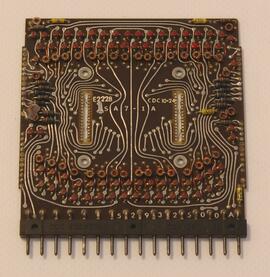
CDC 7600 Module
CERN-OBJ-IT-023 · Item · 1970
Part of Heritage Collection

The CDC 7600 has been created by Seymour Cray. It was designed to be compatible with the 6600, which allows for a substantial increase in performance. Furthermore the rise of new technologies has enabled this performance by reducing the minor cycle clock period from 100 ns to 27.5 ns (4 time faster). A very large machine, the 7600 had over 120 miles of hand-wired interconnections. It was the most powerful computer of its time. However, this speed caused a ground-loop problem causing intermittent faults, and eventually requiring all modules to be fitted with sheathed rubber bands. The CDC 7600 was replaced in 1983 by CRAY-1A.

CDC 7600 Module
CERN-OBJ-IT-023 · Item · 1970
Part of Heritage Collection Test

The CDC 7600 has been created by Seymour Cray. It was designed to be compatible with the 6600, which allows for a substantial increase in performance. Furthermore the rise of new technologies has enabled this performance by reducing the minor cycle clock period from 100 ns to 27.5 ns (4 time faster). A very large machine, the 7600 had over 120 miles of hand-wired interconnections. It was the most powerful computer of its time. However, this speed caused a ground-loop problem causing intermittent faults, and eventually requiring all modules to be fitted with sheathed rubber bands. The CDC 7600 was replaced in 1983 by CRAY-1A.

CDC 7600 module slice
CERN-OBJ-IT-082 · Item
Part of Heritage Collection

Each module contained 8 circuit cards for a total of about 300-500 uncovered transistors packaged with face plates so the Freon plates wouldn't touch the circuits. (cooling plates that surrounded each module).

CDC 7600 module slice
CERN-OBJ-IT-082 · Item
Part of Heritage Collection Test

Each module contained 8 circuit cards for a total of about 300-500 uncovered transistors packaged with face plates so the Freon plates wouldn't touch the circuits. (cooling plates that surrounded each module).

CERN-OBJ-DE-120 · Item
Part of Heritage Collection Test

CELESTA (CERN Latch-up Experiment Student Satellite) will be the first CERN-driven microsatellite, developed in collaboration with the University of Montpellier in the framework of a collaboration agreement defined and signed in 2015. The project, supported through the KT Fund, has two main objectives: one is developing and flying a space version of CERN radiation monitor (RadMon) coupled with a latch-up experiment; the second is showing that the space radiation environment of Low Earth Orbit can be reproduced in the CERN High energy AcceleRator Mixed field facility (CHARM). This would open the use for space system qualification activities, and provide a radiation monitor module for future missions.