This detector is part of the ALICE experiment's Time Projection Chamber (TPC). With incredible precision, the TPC records the thousands of tracks of charged particles spraying out from the collision, allowing each particle to be identified. In such a dense, electronics-filled environment, it is rare to find a relatively empty space - yet most of the TPC's 88m3 volume is filled with just gas, with read-out detectors, like this one located on the outer surface.
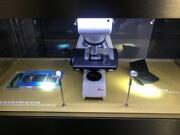
Under the microscope you can see a pixel of silicon from a new generation of high-precision detectors under development for ALICE. The ALICE detector is designed for the periods when the LHC collides the nuclei of lead atoms rather than protons. These lead collisions produce extremely dense tangles of particle tracks and many short-lived particles. Precision is key! The new silicon detectors are extremely thin and can measure the passage of particles with a precision of 5 thousandth’s of a millimetre. The connections to the electronics are integrated into the silicon.
Reflection on theory and experiment. Preparation for the 3rd Zurich talks.Manuscript
Piaget, JeanReflection on theory and experiment. Preparation for the 3rd Zurich talks.Manuscript
Gonseth, FerdinandReflection on theory and experiment. Preparation for the 3rd Zurich talks.Manuscript
Gini, CorradoTheory and experiment in sociology and history. Preparation for the 3rd Zurich talks.Manuscript
Ross-Landi, FeruccioThe Tevatron was the first synchrotron built with superconducting magnets and paved the way for large scale applications of superconductivity. It was installed in the tunnel at Fermi National Accelerator Laboratory, Batavia, Illinois (USA). It operated reliably from 1983 to 2011, producing protons and anti-protons with energies up to 980 GeV. Besides the technology prowess, the Tevatron enabled the discovery of the top quark in 1995, the last fermion of the Standard Model to be observed.