Showing 3833 results

Archivistische beschrijving
1313 results with digital objects Show results with digital objects
ALEPH model
CERN-OBJ-DE-093 · Stuk · 1989
Part of Heritage Collection

A wooden model of the ALEPH experiment and its cavern. ALEPH was one of 4 experiments at CERN's 27km Large Electron Positron collider (LEP) that ran from 1989 to 2000. During 11 years of research, LEP's experiments provided a detailed study of the electroweak interaction. Measurements performed at LEP also proved that there are three – and only three – generations of particles of matter. LEP was closed down on 2 November 2000 to make way for the construction of the Large Hadron Collider in the same tunnel. The cavern and detector are in separate locations - the cavern is stored at CERN and the detector is temporarily on display in Glasgow physics department. Both are available for loan.

CERN-OBJ-DE-094 · Stuk · 2006
Part of Heritage Collection

The ATLAS transition radiation tracker is made of 300'000 straw tubes, up to 144cm long. Filled with a gas mixture and threaded with a wire, each straw is a complete mini-detector in its own right. An electric field is applied between the wire and the outside wall of the straw. As particles pass through, they collide with atoms in the gas, knocking out electrons. The avalanche of electrons is detected as an electrical signal on the wire in the centre. The tracker plays two important roles. Firstly, it makes more position measurements, giving more dots for the computers to join up to recreate the particle tracks. Also, together with the ATLAS calorimeters, it distinguishes between different types of particles depending on whether they emit radiation as they make the transition from the surrounding foil into the straws.

CERN-OBJ-DE-097 · Stuk
Part of Heritage Collection

Under the microscope you can see a pixel of silicon from a new generation of high-precision detectors under development for ALICE. The ALICE detector is designed for the periods when the LHC collides the nuclei of lead atoms rather than protons. These lead collisions produce extremely dense tangles of particle tracks and many short-lived particles. Precision is key! The new silicon detectors are extremely thin and can measure the passage of particles with a precision of 5 thousandth’s of a millimetre. The connections to the electronics are integrated into the silicon.

CMS Brass Absorber
CERN-OBJ-DE-102 · Stuk
Part of Heritage Collection

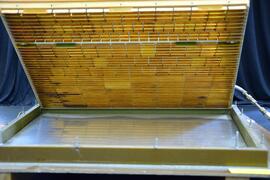
This brass block was part of the CMS experiment. Its role was to slow down particles before their energy was measured. The Compact Muon Solenoid (CMS) experiment is one of two large general-purpose particle physics detectors built on the Large Hadron Collider (LHC).

CERN-OBJ-DE-107 · Stuk
Part of Heritage Collection

This detector is part of the ALICE experiment's Time Projection Chamber (TPC). With incredible precision, the TPC records the thousands of tracks of charged particles spraying out from the collision, allowing each particle to be identified. In such a dense, electronics-filled environment, it is rare to find a relatively empty space - yet most of the TPC's 88m3 volume is filled with just gas, with read-out detectors, like this one located on the outer surface.

ISOLDE target prototype
CERN-OBJ-DE-118 · Stuk
Part of Heritage Collection

Radioactive nuclei are produced at the ISOLDE facility by shooting a high-energy beam of protons on a thick target. By studying some of these nuclei, physicists are improving the knowledge of nucleosynthesis, the process through which stars produce chemical elements. This is a prototype that was developed for the CERN Open Days, in 2019.

[Correspondence]
CERN-ARCH-BEUSCH-W-04 · Reeks · 1960-01-01 - 1992-12-31
Part of Files of Werner Beusch

This series contains correspondence between Beusch and various universities such as ETHZ, research institutes and colleagues. It also includes letters with professors like Jean-Pierre Blaser.

The correspondence between Werner Beusch and Jean-Pierre Blaser was about the renewal of the Venia Legendi (the Venia Legendi is a license to give lectures at universities like for ETHZ as Werner Beusch used for), letters of recommendation for students (Restricted) as well as employing some at CERN for a semester and about his project the OMEGA.