Affichage de 3833 résultats

Description archivistique
1313 résultats avec objets numériques Afficher les résultats avec des objets numériques
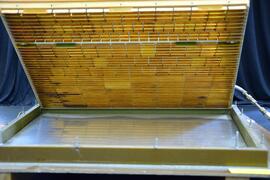
DELPHI Barrel Muon Chamber Module
CERN-OBJ-DE-067 · Pièce · 1989
Fait partie de Heritage Collection

The module was used as part of the muon identification system on the barrel of the DELPHI detector at LEP, and was in active use from 1989 to 2000. The module consists of 7 individual muons chambers arranged in 2 layers. Chambers in the upper layer are staggered by half a chamber width with respect to the lower layer. Each individual chamber is a drift chamber consisting of an anode wire, 47 microns in diameter, and a wrapped copper delay line. Each chamber provided 3 signal for each muon passing through the chamber, from which a 3D space-point could be reconstructed.

Sans titre
CMS Tracker Model
CERN-OBJ-DE-068 · Pièce
Fait partie de Heritage Collection

Model of the tracking detector for the CMS experiment at the LHC. This object is a mock-up of an early design of the CMS Tracker mechanics. It is a segment of a “Wheel” to support Micro-Strip Gas Chamber (MSGC) detector modules on the outer layers and silicon-strip detector modules in the innermost layers. The particularity of that design is that modules are organised in spirals, along which power and optical cables and cooling pipes were planned to be routed. Some of such spirals are illustrated in the mock-up by the colors of the modules. With the detector development it became, however, evident that the silicon detectors would need to be operated in LHC experiments in cold temperatures, while the MSGC could stay in normal room-temperature. That split in two temperatures lead to separating those two detector types by a thermal barrier and therefore jeopardizing the idea of using common, vertical Wheels with services arranged along spirals.

Sans titre
OPAL Muon Chamber
CERN-OBJ-DE-069 · Pièce · 1989-2000
Fait partie de Heritage Collection

OPAL was one of the 4 experiments installed at the LEP particle accelerator from 1989 to 2000. This is a slice of the outermost layer of OPAL : the muon chambers. This outside layer detects particles which are not stopped by the previous layers. These are mostly muons.

CERN-OBJ-DE-074 · Pièce · 2006
Fait partie de Heritage Collection

The ATLAS transition radiation tracker is made of 300'000 straw tubes, up to 144cm long. Filled with a gas mixture and threaded with a wire, each straw is a complete mini-detector in its own right. An electric field is applied between the wire and the outside wall of the straw. As particles pass through, they collide with atoms in the gas, knocking out electrons. The avalanche of electrons is detected as an electrical signal on the wire in the centre. The tracker plays two important roles. Firstly, it makes more position measurements, giving more dots for the computers to join up to recreate the particle tracks. Also, together with the ATLAS calorimeters, it distinguishes between different types of particles depending on whether they emit radiation as they make the transition from the surrounding foil into the straws.

Silicon detector
CERN-OBJ-DE-072 · Pièce
Fait partie de Heritage Collection

Used in LEP experiment. It is a element of the first OPAL silicon strip vertex detector.

ALICE Time of Flight Module
CERN-OBJ-DE-061 · Pièce
Fait partie de Heritage Collection

The Time-Of-Flight system of ALICE consists of 90 such modules, each containing 15 or 19 Multigap Resistive Plate Chamber (MRPC) strips. This detector is used for identification of charged particles. It measures with high precision (50 ps) the time of flight of charged particles and therefore their velocity. The curvature of the particle trajectory inside the magnetic field gives the momentum, thus the particle mass is calculated and the particle is identified The MRPC is a stack of resistive glass plates, separated from each other by nylon fishing line. The mass production of the chambers (~1600, covering a surface of 150 m2) was done at INFN Bologna, while the first prototypes were bult at CERN.

Sans titre