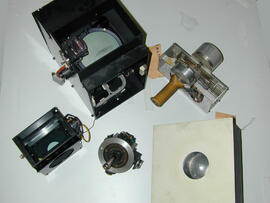
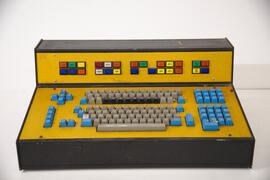
This was the first magnetic horn developed by Simon Van der Meer to collect antiprotons in the AD complex. It was used for the AA (antiproton accumulator). Making an antiproton beam took a lot of time and effort. Firstly, protons were accelerated to an energy of 26 GeV/c (protons at 26GeV/c, antiprotons at 3.6GeV/c) in the PS and ejected onto a metal target. From the spray of emerging particles, a magnetic horn picked out 3.6 GeV antiprotons for injection into the AA through a wide-aperture focusing quadrupole magnet. For a million protons hitting the target, just one antiproton was captured, 'cooled' and accumulated. It took 3 days to make a beam of 3 x 10^11 -, three hundred thousand million - antiprotons. The development of this technology was a key step to the functioning of CERN's Super Proton Synchrotron as a proton - antiproton collider.
A short test version of coil of wire used for the LHC dipole magnets. The high magnetic fields needed for guiding particles around the Large Hadron Collider (LHC) ring are created by passing 12’500 amps of current through coils of superconducting wiring. At very low temperatures, superconductors have no electrical resistance and therefore no power loss. The LHC is the largest superconducting installation ever built. The magnetic field must also be extremely uniform. This means the current flowing in the coils has to be very precisely controlled. Indeed, nowhere before has such precision been achieved at such high currents. Magnet coils are made of copper-clad niobium–titanium cables — each wire in the cable consists of 9’000 niobium–titanium filaments ten times finer than a hair.
With its 27-kilometre circumference, the Large Electron-Positron (LEP) collider was the largest electron-positron accelerator ever built. The excavation of the LEP tunnel was Europe’s largest civil-engineering project prior to the Channel Tunnel. Three tunnel-boring machines started excavating the tunnel in February 1985 and the ring was completed three years later. In its first phase of operation, LEP consisted of 5176 magnets and 128 accelerating cavities. CERN’s accelerator complex provided the particles and four enormous detectors, ALEPH, DELPHI, L3 and OPAL, observed the collisions. LEP was commissioned in July 1989 and the first beam circulated in the collider on 14 July. The collider's initial energy was chosen to be around 91 GeV, so that Z bosons could be produced. The Z boson and its charged partner the W boson, both discovered at CERN in 1983, are responsible for the weak force, which drives the Sun, for example. Observing the creation and decay of the short-lived Z boson was a critical test of the Standard Model. In the seven years that LEP operated at around 100 GeV it produced around 17 million Z particles. In 1995 LEP was upgraded for a second operation phase, with as many as 288 superconducting accelerating cavities added to double the energy so that the collisions could produce pairs of W bosons. The collider's energy eventually topped 209 GeV in 2000. This object is one of the superconducting cavities from this epoch.
Sans titreA short section of the LHC beam-pipe including beam screen. In the LHC, particles circulate under vacuum. The vacuum chamber can be at room temperature (for example, in the experimental areas), or at cryogenic temperature, in the superconductive magnets. This piece is located in the superconductive magnets. The outer pipe is the vacuum chamber, which is in contact with the magnets, at cryogenic temperature (1.9K). It is called the “cold bore”. The inner tube is the beam screen. Its main goal is to protect the magnets from the heat load coming from the synchrotron radiation. Indeed, when high energy protons’ trajectory is bent, photons are emitted by the beam. They are intercepted by the beam screen. The temperature of the beam screen is kept between 5 and 20K by a circulation of gaseous helium in the small pipes on both sides of the beam screen. As those surfaces are at cryogenic temperature. The residual gas present in the accelerator is sticking on the surfaces. This phenomenon called “adsorption” is used to maintain a very low pressure in the vacuum chamber of the accelerator. About materials: The cold bore is in stainless steel. The beam screen is in stainless steel with colaminated copper. Both those material have a low outgassing rates, which means that they release few molecules in the vacuum chamber. About beam and impedance: The goal of the copper, which has a good electrical conductivity, is to facilitate the circulation of the image current. The beam is composed of charged particules circulating: it is an electric current. When it is circulating, an image current is produced. It is called induction. If the image current cannot circulate properly, the beam is slowed down. About adsorption process: When the beam circulates, photons from synchrotron radiation are emitted and hit the beam screen. By doing so, they desorb molecules from the walls. The molecules are then pumped down on the outer pipe (where they cannot be reached by the photons anymore), through the small holes in the beam screen.
120 tonnes of liquid helium in use at the Large Hadron Collider, cooling 36'000 tonnes of superconducting magnets to just 1.9 degrees above absolute zero. The cryogenic valves were designed for the needs of CERN to develop valves for use with the very low temperature of liquid helium.
The pulse of a particle accelerator. 128 of these radio frequency cavities were positioned around CERN's 27-kilometre LEP ring to accelerate electrons and positrons. The acceleration was produced by microwave electric oscillations at 352 MHz. The electrons and positrons were grouped into bunches, like beads on a string, and the copper sphere at the top stored the microwave energy between the passage of individual bunches. This made for valuable energy savings as it reduced the heat generated in the cavity.
Boxes of bubble chamber film showing photographs of particle collisions. The particle tracks were then analysed on scanning tables (see object CERN-OBJ-DE-029). We have a selection of bubble chamber film available for loan, including some from the Big European Bubble Chamber (BEBC).
The UA2 central calorimeter measured the energy of individual particles created in proton-antiproton collisions. Accurate calibration allowed the W and Z masses to be measured with a precision of about 1%. The calorimeter had 24 slices like this one, each weighing 4 tons. The slices were arranged like orange segments around the collision point. Incoming particles produced showers of secondary particles in the layers of heavy material. These showers passed through the layers of plastic scintillator, generating light which was taken by light guides (green) to the data collection electronics. The amount of light was proportional to the energy of the original particle. The inner 23 cm of lead and plastic sandwiches measured electrons and photons; the outer 80 cm of iron and plastic sandwiches measured strongly interacting hadrons. The detector was calibrated by injecting light through optical fibres or by placing a radioactive source in the tube on the bottom edge.
The 3.70 metre Big European Bubble Chamber (BEBC) was dismantled on 9 August 1984. One of the biggest detectors in the world, it produced direct visual recording of particle tracks. 6.3 million photos of interactions were taken with the chamber in the course of its existence.
<3> pieces. Mesures are of the largest one. Multi-wire detectors contain layers of positively and negatively charged wires enclosed in a chamber full of gas. A charged particle passing through the chamber knocks negatively charged electrons out of atoms in the gas, leaving behind positive ions. The electrons are pulled towards the positively charged wires. They collide with other atoms on the way, producing an avalanche of electrons and ions. The movement of these electrons and ions induces an electric pulse in the wires which is collected by fast electronics. The size of the pulse is proportional to the energy loss of the original particle.