Showing 3833 results

Archival description
1153 results with digital objects Show results with digital objects
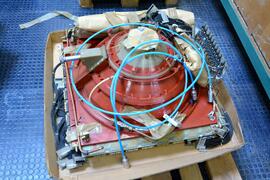
wire chamber
CERN-OBJ-DE-051 · Item · 1985
Part of Heritage Collection Test

Multi-wire detectors contain layers of positively and negatively charged wires enclosed in a chamber full of gas. A charged particle passing through the chamber knocks negatively charged electrons out of atoms in the gas, leaving behind positive ions. The electrons are pulled towards the positively charged wires. They collide with other atoms on the way, producing an avalanche of electrons and ions. The movement of these electrons and ions induces an electric pulse in the wires which is collected by fast electronics. The size of the pulse is proportional to the energy loss of the original particle.

wire chamber
CERN-OBJ-DE-004 · Item
Part of Heritage Collection Test

Was used in ISR (Intersecting Storage Ring) split field magnet experiment. Multi-wire detectors contain layers of positively and negatively charged wires enclosed in a chamber full of gas. A charged particle passing through the chamber knocks negatively charged electrons out of atoms in the gas, leaving behind positive ions. The electrons are pulled towards the positively charged wires. They collide with other atoms on the way, producing an avalanche of electrons and ions. The movement of these electrons and ions induces an electric pulse in the wires which is collected by fast electronics. The size of the pulse is proportional to the energy loss of the original particle.

Wire chamber
CERN-OBJ-DE-040 · Item · 1967
Part of Heritage Collection

Magnetoscriptive readout wire chamber.Multi-wire detectors contain layers of positively and negatively charged wires enclosed in a chamber full of gas. A charged particle passing through the chamber knocks negatively charged electrons out of atoms in the gas, leaving behind positive ions. The electrons are pulled towards the positively charged wires. They collide with other atoms on the way, producing an avalanche of electrons and ions. The movement of these electrons and ions induces an electric pulse in the wires which is collected by fast electronics. The size of the pulse is proportional to the energy loss of the original particle.

Wire Chamber
CERN-OBJ-DE-041 · Item
Part of Heritage Collection

Magnetoscriptive readout wire chamber. Multi-wire detectors contain layers of positively and negatively charged wires enclosed in a chamber full of gas. A charged particle passing through the chamber knocks negatively charged electrons out of atoms in the gas, leaving behind positive ions. The electrons are pulled towards the positively charged wires. They collide with other atoms on the way, producing an avalanche of electrons and ions. The movement of these electrons and ions induces an electric pulse in the wires which is collected by fast electronics. The size of the pulse is proportional to the energy loss of the original particle.

wire chamber
CERN-OBJ-DE-048 · Item
Part of Heritage Collection

Multi-wire detectors contain layers of positively and negatively charged wires enclosed in a chamber full of gas. A charged particle passing through the chamber knocks negatively charged electrons out of atoms in the gas, leaving behind positive ions. The electrons are pulled towards the positively charged wires. They collide with other atoms on the way, producing an avalanche of electrons and ions. The movement of these electrons and ions induces an electric pulse in the wires which is collected by fast electronics. The size of the pulse is proportional to the energy loss of the original particle.

Wire chamber
CERN-OBJ-DE-050 · Item
Part of Heritage Collection Test

Multi-wire detectors contain layers of positively and negatively charged wires enclosed in a chamber full of gas. A charged particle passing through the chamber knocks negatively charged electrons out of atoms in the gas, leaving behind positive ions. The electrons are pulled towards the positively charged wires. They collide with other atoms on the way, producing an avalanche of electrons and ions. The movement of these electrons and ions induces an electric pulse in the wires which is collected by fast electronics. The size of the pulse is proportional to the energy loss of the original particle.

wire chamber
CERN-OBJ-DE-004 · Item
Part of Heritage Collection Test

Was used in ISR (Intersecting Storage Ring) split field magnet experiment. Multi-wire detectors contain layers of positively and negatively charged wires enclosed in a chamber full of gas. A charged particle passing through the chamber knocks negatively charged electrons out of atoms in the gas, leaving behind positive ions. The electrons are pulled towards the positively charged wires. They collide with other atoms on the way, producing an avalanche of electrons and ions. The movement of these electrons and ions induces an electric pulse in the wires which is collected by fast electronics. The size of the pulse is proportional to the energy loss of the original particle.