Model of the tracking detector for the CMS experiment at the LHC. This object is a mock-up of an early design of the CMS Tracker mechanics. It is a segment of a “Wheel” to support Micro-Strip Gas Chamber (MSGC) detector modules on the outer layers and silicon-strip detector modules in the innermost layers. The particularity of that design is that modules are organised in spirals, along which power and optical cables and cooling pipes were planned to be routed. Some of such spirals are illustrated in the mock-up by the colors of the modules. With the detector development it became, however, evident that the silicon detectors would need to be operated in LHC experiments in cold temperatures, while the MSGC could stay in normal room-temperature. That split in two temperatures lead to separating those two detector types by a thermal barrier and therefore jeopardizing the idea of using common, vertical Wheels with services arranged along spirals.
Antti OnnelaA beautiful module of tracker from the CMS experiment, made up of silicon.
A beautiful module of tracker from the CMS experiment, made up of silicon.
The crystals used in CMS’s electromagnetic calorimeter may look like simple bricks of glass, but they are in fact mostly metal and are heavier than steel! Lead tungstate crystal with a touch of oxygen in this crystalline form is highly transparent and scintillates when electrons and photons pass through it. This means it produces light in proportion to the particle’s energy. CMS contains nearly 80’000 such crystals, each of which took two days to grow. This technology developed at CERN has applications in medical imaging, for example improving cancer diagnosis. The Compact Muon Solenoid (CMS) is a general-purpose detector at the Large Hadron Collider (LHC).
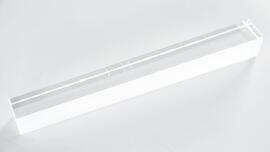
The crystals used in CMS’s electromagnetic calorimeter may look like simple bricks of glass, but they are in fact mostly metal and are heavier than steel! Lead tungstate crystal with a touch of oxygen in this crystalline form is highly transparent and scintillates when electrons and photons pass through it. This means it produces light in proportion to the particle’s energy. CMS contains nearly 80’000 such crystals, each of which took two days to grow. This technology developed at CERN has applications in medical imaging, for example improving cancer diagnosis. The Compact Muon Solenoid (CMS) is a general-purpose detector at the Large Hadron Collider (LHC).
This brass block was part of the CMS experiment. Its role was to slow down particles before their energy was measured. The Compact Muon Solenoid (CMS) experiment is one of two large general-purpose particle physics detectors built on the Large Hadron Collider (LHC).
This brass block was part of the CMS experiment. Its role was to slow down particles before their energy was measured. The Compact Muon Solenoid (CMS) experiment is one of two large general-purpose particle physics detectors built on the Large Hadron Collider (LHC).

Looking for a c-number ("classical") solution of the equation in the title.Manuscript
Ruelle, David