Medipix is a family of read-out chips for particle imaging and detection developed by the Medipix Collaborations. The original concept is that it works like a camera, detecting and counting each individual particle hitting the pixels when its electronic shutter is open. This enables high-resolution, high-contrast, noise hit free images – making it unique for imaging applications. Hybrid pixel detector technology was initially developed to address the needs of particle tracking at the CERN LHC. The Medipix1 chip, which uses identical front-end circuitry to the Omega3 particle tracking chip, demonstrated the great potential for the technology outside of high-energy physics. To further develop this novel technology and take it into new scientific fields the Medipix2 Collaboration was started in 1999, the Medipix3 collaboration in 2005 and finally the Medipix4 collaboration in 2016.
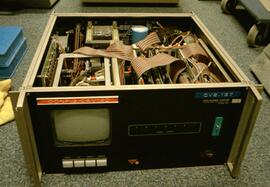
CAVIAR (CAMAC Video Autonomous Read-out), developed about 1980 at CERN in Geneva, was a multi-purpose microcomputer for the interactive development, in-line control and monitoring of experiments in high-energy physics. The CAVIAR machine was used in conjunction with a CAMAC system, consisting of a set of I/O modules assembled in a 19" crate. Some of the CAMAC-modules (for instance, analog-to-digital converters) would directly be connected to measuring devices, while another module would give access to a host (mainframe) computer through a high-speed link. The CAVIAR uses a Motorola 6800 microprocessor with 32 kB of solid-state RAM. In 29 kB EPROM the BAMBI (BASIC-like) interpreter is stored. Using the BAMBI graphics commands, graphs and histograms can be shown on the built-in miniature monitor screen. An alphanumeric terminal is connected to CAVIAR for programming and entering commands. The Super-CAVIAR (shown in the picture) is an enhanced version of CAVIAR with 64 kB RAM, 84 kB EPROM and other improvements.
The CMS (Compact Muon Solenoid) Tile Calorimeter is a pivotal component of the CMS detector, which is one of the major experiments at the Large Hadron Collider (LHC) at CERN. Designed to measure the energy of particles, the calorimeter plays an essential role in the study of high-energy physics.

One of the two "ASM/2-32EM" boxes installed in 1988, from "Cisco Systems Inc." - then an unknown 20-employee company in Menlo Park, California (USA). This is one of the first two Cisco boxes to appear in Switzerland, and possibly Europe. The 220v power supply was a special modification made for use at CERN. They supported IP address filtering, which seemed just what CERN needed to help protect the new Cray XMP-48 super computer from network hackers. The two ASM boxes were both routers and terminal servers. They protected a secure private Ethernet segment used by the Cray project, as well as providing secure terminal connections to that segment, including CERN's first dialback terminal service, which allowed Cray and CERN system analysts to work on the machine from home, using another Cisco feature called TACACS. (Kindly offered by B. Segal who discovered this company while at a Usenix Conference in Phoenix, Arizona in June 1987.)
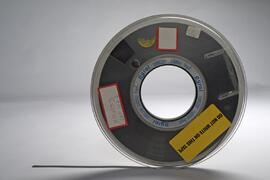
With arrival of CDC 6600 at CERN in January 1965, there came the first half-inch wide 7-tracks tape units with magnetic tapes at recording densities of 200, 556 and 800 bpi (bytes per inch).
This magnetic disk was one of three which interfaced with various Control Data machines. This single platter came from a Control Data 7638 Disk Storage Subsystem and could contain up to 10MB - about the size of a few MP4's on your iPod.

The 3390 disks rotated faster than those in the previous model 3380. Faster disk rotation reduced rotational delay (ie. the time required for the correct area of the disk surface to move to the point where data could be read or written). In the 3390's initial models, the average rotational delay was reduced to 7.1 milliseconds from 8.3 milliseconds for the 3380 family.

These are sample fibre optic cables which are used for networking. Optical fibers are widely used in fiber-optic communications, where they permit transmission over longer distances and at higher bandwidths (data rates) than wire cables. Fibers are used instead of metal wires because signals travel along them with less loss and are also immune to electromagnetic interference. This is useful for somewhere like CERN where magnets with their highly powerful magnetic fields could pose a problem.
It was the first member of the VAX family of computers, the first commercially available 32-bit computer and the first MIPS (one million instructions per second). It is a family of abandoned mini-computers developed and manufactured by Digital Equipment Corporation (DEC). The name "VAX" comes from an acronym for "Virtual address eXtension" as the successor to the PDP-11. The computer and its operating system (VMS) were designed from scratch. The result was a truly reliable, powerful and user-friendly system. In addition its affordable price has enabled many institutions and universities to acquire it.

Now called RSA SecurID, SecurID is a mechanism developed by Security Dynamics that allows two-factor authentication for a user on a network resource. It works on the principle of the unique password mode, based on a shared secret. Every sixty seconds, the component generates a new six-digit token on the screen. The latter comes from the current time (internal clock) and the seed (SecurID private key that is available on the component, and is also from the SecurID server). During an authentication request, the SecurID server will check the entered token by performing exactly the same calculation as that performed by your component. The server knows the two information required for this calculation: the current time and the seed of your component. Access is allowed if the token calculated by the server matches the token you specified.