A magnet surrounding the detectors bends the paths of charged particles. This shows if they are positively - or negatively- charged and also allows their momentum to be measured. Inside ATLAS, the solenoid magnet surrounding the tracking detectors must be as thin as possible, so as not to affect their measurements. 9 km of superconducting wires, support casing, cooling fluids and insulation is squeezed into the 4.5 cm gap between the tracking detectors and the calorimeters. ATLAS is one of the 4 large experiments surrounding collision points at the Large Hadron Collider.
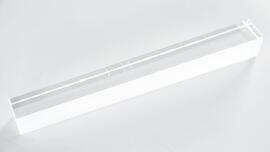
The crystals used in CMS’s electromagnetic calorimeter may look like simple bricks of glass, but they are in fact mostly metal and are heavier than steel! Lead tungstate crystal with a touch of oxygen in this crystalline form is highly transparent and scintillates when electrons and photons pass through it. This means it produces light in proportion to the particle’s energy. CMS contains nearly 80’000 such crystals, each of which took two days to grow. This technology developed at CERN has applications in medical imaging, for example improving cancer diagnosis. The Compact Muon Solenoid (CMS) is a general-purpose detector at the Large Hadron Collider (LHC).
The electromagnetic calorimeter used in LHCb is a sandwich of lead plates and scintillating tiles. Incoming particles interact with the lead, creating a shower of new particles. This shower goes on to interact with the plastic tiles where its energy is transformed into tiny flashes of light, called scintillations. All this light is then collected in optical fibres which transport it to a photomultiplier tube that converts the light signal into a pulse of electrical current. The resulting signal reveals the energy of the original particle. 3300 such modules combine to make up the first layer of LHCb calorimeters.
Each of these straws is a complete mini–detector in its own right. Every one is filled with a gas mixture and threaded with a wire. Imagine assembling 300’000 fragile drinking straws up to 144 cm long, with no bends or kinks allowed! This layer of tracker plays two important roles. Firstly, it makes more position measurements, giving more dots for the computers to join up to recreate the particle tracks. Then it also helps distinguish between different types of particles depending on whether they emit radiation as they make the transition from the surrounding foil into the straws. An electric field is applied between the wire and the outside wall of the straw. As particles pass through, they collide with atoms in the gas, knocking out electrons. The avalanche of electrons is detected as an electrical signal on the wire in the centre.
This antimatter trap is used at the Antimatter decelerator to study atoms of antimatter. Electrically-charged antimatter can be trapped in this device, also called a Penning trap. The Penning trap requires an ultrahigh vacuum. Inside the trap, magnetic fields force the charged antiparticles to spiral around the magnetic field lines, and electric fields confine them along the magnetic axis. Even though at the beginning of the universe, antimatter has been produced in equal quantity with matter, it now seems to have completely disappeared.
CELESTA (CERN Latch-up Experiment Student Satellite) will be the first CERN-driven microsatellite, developed in collaboration with the University of Montpellier in the framework of a collaboration agreement defined and signed in 2015. The project, supported through the KT Fund, has two main objectives: one is developing and flying a space version of CERN radiation monitor (RadMon) coupled with a latch-up experiment; the second is showing that the space radiation environment of Low Earth Orbit can be reproduced in the CERN High energy AcceleRator Mixed field facility (CHARM). This would open the use for space system qualification activities, and provide a radiation monitor module for future missions.
An ionization chamber with fast timing properties was built at CERN for measuring fission cross-sections of minor actinides at the n_TOF neutron beam. The design of this chamber and of the front-end electronics was optimized to match the innovative features of the n_TOF facility, in particular the high instantaneous neutron flux and low background. Micromegas (Micro-MEsh Gaseous Structure) detectors are gas detectors consisting of a stack of one ionization and one proportional chamber. A micromesh separates the two communicating regions, where two different electric fields establish respectively a charge drift and a charge multiplication regime. The n_TOF facility at CERN provides a white neutron beam (from thermal up to GeV neutrons) for neutron induced cross section measurements.
A half shell of the barrel CMS Pixel Phase-0 that was installed at the start-up of the Large Hadron Collider (2009-2016 in operation) and has been involved in the discovery of the Higgs boson.
A good dozen different targets are available for ISOLDE, made of different materials and equipped with different kinds of ion-sources, according to the needs of the experiments. Each separator (GPS: general purpose; HRS: high resolution) has its own target. Because of the high radiation levels, robots effect the target changes, about 80 times per year. In the standard unit shown in picture _01, the target is the cylindrical object in the front. It contains uranium-carbide kept at a temperature of 2200 deg C, necessary for the isotopes to be able to escape. At either end, one sees the heater current leads, carrying 700 A. The Booster beam, some 3E13 protons per pulse, enters the target from left. The evaporated isotope atoms enter a hot-plasma ion source (the black object behind the target). The whole unit sits at 60 kV potential (pulsed in synchronism with the arrival of the Booster beam) which accelerates the ions (away from the viewer) towards one of the 2 separators.