Affichage de 3959 résultats

Description archivistique
1316 résultats avec objets numériques Afficher les résultats avec des objets numériques
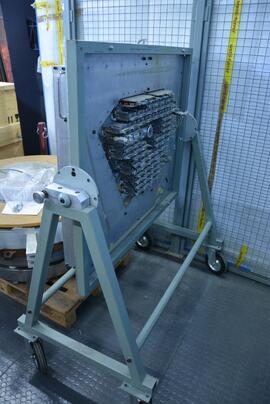
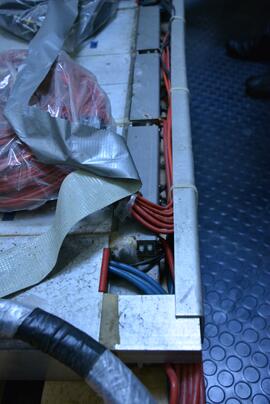
Wire chamber
CERN-OBJ-DE-040 · Pièce · 1967
Fait partie de Heritage Collection

Magnetoscriptive readout wire chamber.Multi-wire detectors contain layers of positively and negatively charged wires enclosed in a chamber full of gas. A charged particle passing through the chamber knocks negatively charged electrons out of atoms in the gas, leaving behind positive ions. The electrons are pulled towards the positively charged wires. They collide with other atoms on the way, producing an avalanche of electrons and ions. The movement of these electrons and ions induces an electric pulse in the wires which is collected by fast electronics. The size of the pulse is proportional to the energy loss of the original particle.

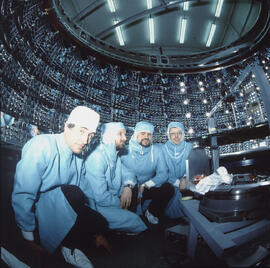
DELPHI Silicon Tracker
CERN-OBJ-DE-052 · Pièce
Fait partie de Heritage Collection

DELPHI was one of the four experiments installed at the LEP particle accelerator from 1989 - 2000. The silicon tracking detector was nearest to the collision point in the centre of the detector. It was used to pinpoint the collision and catch short-lived particles.

CERN-OBJ-DE-053 · Pièce
Fait partie de Heritage Collection

DELPHI was one of the four experiments installed at the LEP particle accelerator from 1989 - 2000. This is a piece of the Barrel Ring Imaging Cherenkov detector which was used to identify particles in DELPHI.It measured the Cherenkov light emitted when particles travelled faster than the speed of light through the material of the detector. The photo shows the complete Cherenkov detector.

CERN-OBJ-DE-056 · Pièce
Fait partie de Heritage Collection

OPAL was one of the four experiments installed at the LEP particle accelerator from 1989 - 2000. OPAL's central tracking system consists of (in order of increasing radius) a silicon microvertex detector, a vertex detector, a jet chamber, and z-chambers. All the tracking detectors work by observing the ionization of atoms by charged particles passing by: when the atoms are ionized, electrons are knocked out of their atomic orbitals, and are then able to move freely in the detector. These ionization electrons are detected in the different parts of the tracking system. (This piece includes the vertex, jet and Z chambers) In the picture above, the central detector is the piece being removed to the right.

OPAL Various Lead Glass Blocks
CERN-OBJ-DE-058 · Pièce
Fait partie de Heritage Collection

These lead glass blocks were part of a CERN detector called OPAL (one of the four experiments at the LEP particle detector). OPAL uses some 12 000 blocks of glass like this to measure particle energies in the electromagnetic calorimeter. This detector measured the energy deposited when electrons and photons were slowed down and stopped.

CERN-OBJ-DE-085 · Pièce · 1980
Fait partie de Heritage Collection

This is a prototype endplate piece constructed during R&D for the ALEPH Time Projection Chamber (TPC). ALEPH was one of 4 experiments at CERN's 27km Large Electron Positron collider (LEP) that ran from 1989 to 2000. ALEPH's TPC was a large-volume tracking chamber, 4.4 metres long and 3.6 metres in diameter - the largest TPC in existance at the time. This object is one of the endplates of a “Kind” sector, the smallest of the three types of sectors. The patterns etched into the copper form the cathode pads that measured particle track coordinates in the r-phi direction. It included a laser calibration system, a gating system to prevent space charge buildup, and a new radial pad geometry to improve resolution. the ALEPH TPC allowed for precise momentum measurements of the high-momentum particles from W and Z decays. The following institutes participated: CERN, Athens, Glasgow, Mainz, MPI Munich, INFN-Pisa, INFN-Trieste, Wisconsin.