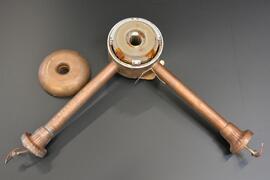
The SC (synchro-cyclotron) was the first accelerator built at CERN. It operated from August 1957 until it was closed down at the end of 1990.
Prototype of UA1 central detector inside a plexi tube. The UA1 experiment ran at CERN's Super Proton Synchrotron and made the Nobel Prize winning discovery of W and Z particles in 1983. The UA1 central detector was crucial to understanding the complex topology of proton-antiproton events. It played a most important role in identifying a handful of Ws and Zs among billions of collisions. The detector was essentially a wire chamber - a 6-chamber cylindrical assembly 5.8 m long and 2.3 m in diameter, the largest imaging drift chamber of its day. It recorded the tracks of charged particles curving in a 0.7 Tesla magnetic field, measuring their momentum, the sign of their electric charge and their rate of energy loss (dE/dx). Atoms in the argon-ethane gas mixture filling the chambers were ionised by the passage of charged particles. The electrons which were released drifted along an electric field shaped by field wires and were collected on sense wires. The geometrical arrangement of the 17000 field wires and 6125 sense wires allowed a spectacular 3-D interactive display of reconstructed physics events to be produced.
Sans titreWhen you look through the glass at a picture behind, the picture appears raised up because light is slowed down in the dense glass. It is this density (4.06 gcm-3) that makes lead glass attractive to physicists. The refractive index of the glass is 1.708 at 400nm (violet light), meaning that light travels in the glass at about 58% its normal speed. At CERN, the OPAL detector uses some 12000 blocks of glass like this to measure particle energies.
Sans titreWas used in ISR (Intersecting Storage Ring) split field magnet experiment. Multi-wire detectors contain layers of positively and negatively charged wires enclosed in a chamber full of gas. A charged particle passing through the chamber knocks negatively charged electrons out of atoms in the gas, leaving behind positive ions. The electrons are pulled towards the positively charged wires. They collide with other atoms on the way, producing an avalanche of electrons and ions. The movement of these electrons and ions induces an electric pulse in the wires which is collected by fast electronics. The size of the pulse is proportional to the energy loss of the original particle.
This is a calorimeter, a detector which measures the energy of particles. When in use, it is filled with liquid krypton at -152°C. Electrons and photons passing through interact with the krypton, creating a shower of charged particles which are collected on the copper ribbons. The ribbons are aligned to an accuracy of a tenth of a millimetre. The folding at each end allows them to be kept absolutely flat. Each shower of particles also creates a signal in scintillating material embedded in the support disks. These flashes of light are transmitted to electronics by the optical fibres along the side of the detector. They give the time at which the interaction occurred. The photo shows the calorimeter at NA48, a CERN experiment which is trying to understand the lack of anti-matter in the Universe today.
Gargamelle was the name given to a big bubble chamber built at the Saclay Laboratory in France during the late 1960s. It was designed principally for the detection at CERN of the elusive particles called neutrinos.In 1973, André Lagarrigue and his colleagues found evidence for neutral currents in Gargamelle bubble chamber pictures. Gargamelle is on display at CERN in the Microcosm garden.
Lens from the RCBC (rapid cycling bubble chamber). Quantity: 2 lenses
30cm diameter hydrogen bubble chamber for the SC (synchro-cyclotron)
Prototype made by Breskin.Has never been used. Breskin was a ph.d student working under Charpak supervision. The dimensions include the support.
Sans titre