Reference to "The expansion of the universe, Paul Condere"
Pauli, WolfgangElectromagnetic Field in Quantized Space-Time Lorentz invariant space-time.Manuscript
Snyder, Hartland SPaper related to the celebration of the 50th anniversary of the theory of the relativity.Article
Bondi, HNotes on eigenvalues.Notes
[Ferretti]Each of these straws is a complete mini–detector in its own right. Every one is filled with a gas mixture and threaded with a wire. Imagine assembling 300’000 fragile drinking straws up to 144 cm long, with no bends or kinks allowed! This layer of tracker plays two important roles. Firstly, it makes more position measurements, giving more dots for the computers to join up to recreate the particle tracks. Then it also helps distinguish between different types of particles depending on whether they emit radiation as they make the transition from the surrounding foil into the straws. An electric field is applied between the wire and the outside wall of the straw. As particles pass through, they collide with atoms in the gas, knocking out electrons. The avalanche of electrons is detected as an electrical signal on the wire in the centre.
A magnet surrounding the detectors bends the paths of charged particles. This shows if they are positively - or negatively- charged and also allows their momentum to be measured. Inside ATLAS, the solenoid magnet surrounding the tracking detectors must be as thin as possible, so as not to affect their measurements. 9 km of superconducting wires, support casing, cooling fluids and insulation is squeezed into the 4.5 cm gap between the tracking detectors and the calorimeters. ATLAS is one of the 4 large experiments surrounding collision points at the Large Hadron Collider.
The innermost layers of all four LHC detectors are made of silicon. This piece comes from the ATLAS detector where its job is to record the paths of the particles close to the collision. Here, hundreds of particles spray outwards and the silicon detectors must identify the exact points from which the particles originate and make an accurate measurement of the curvature of every particle track. Inside ATLAS, the first layer is made of 80 million silicon pixels, each smaller than a grain of sand. Surrounding the pixels are six million silicon strips, each about the thickness of a hair. The object on display here contains 1536 such silicon strips. Together, the layers of tracking detectors are like a giant 92 mega pixel camera taking a photo 40 million times every second.
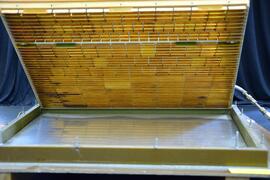
The first layer of the ATLAS detector’s calorimeter is made of 8’200 lead plates and electrodes folded into an accordion shape and immersed in liquid argon. ATLAS (A Toroidal LHC ApparatuS) is the largest, general-purpose particle detector experiment at the Large Hadron Collider (LHC). As particles cross the folds and interact with the lead atoms, electrons and photons are ejected. There is a knock-on effect and as they continue on into the argon, a whole shower of secondary particles is produced. The electrodes register a signal that gives a measurement of the energy of the initial particle. As with most of the LHC detectors, the structural design challenge is to hold the heavy elements in place without affecting the measurements of the particles. Here, the layers of honeycomb spacer are designed to do just that. They separate the copper electrode layer from the lead and stainless steel absorber, allowing the liquid argon to flow freely in between.
This detector is part of the ALICE experiment's Time Projection Chamber (TPC). With incredible precision, the TPC records the thousands of tracks of charged particles spraying out from the collision, allowing each particle to be identified. In such a dense, electronics-filled environment, it is rare to find a relatively empty space - yet most of the TPC's 88m3 volume is filled with just gas, with read-out detectors, like this one located on the outer surface.
Under the microscope you can see a pixel of silicon from a new generation of high-precision detectors under development for ALICE. The ALICE detector is designed for the periods when the LHC collides the nuclei of lead atoms rather than protons. These lead collisions produce extremely dense tangles of particle tracks and many short-lived particles. Precision is key! The new silicon detectors are extremely thin and can measure the passage of particles with a precision of 5 thousandth’s of a millimetre. The connections to the electronics are integrated into the silicon.