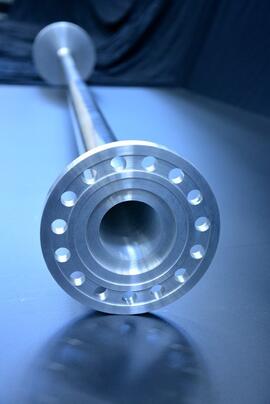
Slice of the Large Hadron Collider (LHC) prototype beam tubes in dipole magnet The LHC is the world’s largest and most powerful particle accelerator that accelerates and collides two beams of protons or ions to near the speed of light in opposite directions. It first started up in 2008, and is the latest addition to CERN’s accelerator complex (2025). The LHC consists of a 27-km ring of superconducting magnets with a number of accelerating structures to boost the energy of the particles along the way. Thousands of magnets of different varieties and sizes are used to direct the beams around the accelerator. The high bending and accelerating fields needed can only be reached using superconductor magnets at very low temperature (‑271.3°C). There are 1232 dipole magnets like this prototype in the LHC, used to guide the particles around the 27 km ring. Dipole magnets must have an extremely uniform field, which means the current flowing in the coils that produce the magnetic field has to be very precisely controlled. Nowhere before has such precision been achieved at such high currents. The temperature is measured to five thousandths of a degree, the current to one part in a million. The current creating the magnetic field pass through superconducting wires at up to 12 500 amps, about 30 000 times the current flowing in a 100 W light bulb. Since the LHC accelerate two particle beams moving in opposite directions, it is really two accelerators in one. To keep the machine as compact and economical as possible, two dipole magnets are built into a single housing.
Sem títuloA monorail from CERN's Large Electron Positron collider (LEP, for short). It ran around the 27km tunnel, transporting equipment and personnel. With its 27-kilometre circumference, LEP was the largest electron-positron accelerator ever built and ran from 1989 to 2000. During 11 years of research, LEP's experiments provided a detailed study of the electroweak interaction. Measurements performed at LEP also proved that there are three – and only three – generations of particles of matter. LEP was closed down on 2 November 2000 to make way for the construction of the Large Hadron Collider in the same tunnel.
When you look through the glass at a picture behind, the picture appears raised up because light is slowed down in the dense glass. It is this density (4.06 gcm-3) that makes lead glass attractive to physicists. The refractive index of the glass is 1.708 at 400nm (violet light), meaning that light travels in the glass at about 58% its normal speed. At CERN, the OPAL detector uses some 12000 blocks of glass like this to measure particle energies.
Sem título<2> full boxes of light guides. Light guides like this are used to carry signals to the electronics for recording.
This is a calorimeter, a detector which measures the energy of particles. When in use, it is filled with liquid krypton at -152°C. Electrons and photons passing through interact with the krypton, creating a shower of charged particles which are collected on the copper ribbons. The ribbons are aligned to an accuracy of a tenth of a millimetre. The folding at each end allows them to be kept absolutely flat. Each shower of particles also creates a signal in scintillating material embedded in the support disks. These flashes of light are transmitted to electronics by the optical fibres along the side of the detector. They give the time at which the interaction occurred. The photo shows the calorimeter at NA48, a CERN experiment which is trying to understand the lack of anti-matter in the Universe today.
Before the days of electronic detectors, visual techniques were used to detect particles, using detectors such as spark chambers and bubble chambers. This plexiglass lens was used to focus the image of tracks so they could be photographed.
A drift tube from the Linac 1. This was the first tank of the linear accelerator Linac1, the injection system for the Proton Synchrotron, It ran for 34 years (1958 - 1992). Protons entered at the far end and were accelerated between the copper drift tubes by an oscillating electromagnetic field. The field flipped 200 million times a second (200 MHz) so the protons spent 5 nanoseconds crossing a drift tube and a gap. Moving down the tank, the tubes and gaps had to get longer as the protons gained speed. The tank accelerated protons from 500 KeV to 10 MeV. Linac1 was also used to accelerate deutrons and alpha particles for the Intersecting Storage Rings and oxygen and sulpher ions for the Super Proton Synchrotron heavy ion programme.
Sem títuloOn the inside of the cavity there is a layer of niobium. Operating at 4.2 degrees above absolute zero, the niobium is superconducting and carries an accelerating field of 6 million volts per metre with negligible losses. Each cavity has a surface of 6 m2. The niobium layer is only 1.2 microns thick, ten times thinner than a hair. Such a large area had never been coated to such a high accuracy. A speck of dust could ruin the performance of the whole cavity so the work had to be done in an extremely clean environment.
3 bubble chamber film rolls from the 2m bubble chamber.