Mostrando 3959 resultados

Descripción archivística
1316 resultados con objetos digitales Muestra los resultados con objetos digitales
6250 BPI IBM reduce version 3.3
CERN-OBJ-IT-098 · Unidad documental simple · 1988
Parte de Heritage Collection

These are magnetic coil bands designed by IBM with 6250 BPI. BPI means bits per inch and specifies the data density a magnetic coil can hold.

Intel Core 2 Duo Processor E6600
CERN-OBJ-IT-100 · Unidad documental simple
Parte de Heritage Collection

This processor relies on two key points: maximum performance and minimum heat output. 4M Cache ; frequency 2.40 GHz ; 1066 MHz FSB

CDC 3300 Timing Disk
CERN-OBJ-IT-106 · Unidad documental simple
Parte de Heritage Collection

It's a timing disc from the CDC 3300 computer. This computer was released in 1965. Moreover CDC means Control Data Corporation.

System Software 7 Macintosh
CERN-OBJ-IT-108 · Unidad documental simple · 1991
Parte de Heritage Collection

System 7 is a single-user graphical user interface-based operating system for Macintosh computers and was part of the classic Mac OS line of operating systems. It was introduced on May 13, 1991, by Apple Computer. It succeeded System 6, and was the main Macintosh operating system until it was succeeded by Mac OS 8 in 1997. Features added with the System 7 release included virtual memory, personal file sharing, QuickTime, QuickDraw 3D, and an improved user interface. This is the first real major evolution of the Macintosh system, bringing a significant improvement in the user interface, improved stability and many new features such as the ability to use multiple applications at the same time. "System 7" is the last operating system name of the Macintosh that contains the word "system". Macintosh operating systems were later called "Mac OS" (for Macintosh Operating System).
Weston Standard battery
CERN-OBJ-IT-113 · Unidad documental simple
Parte de Heritage Collection

This is a Weston AOIP standard battery with its calibration certificate (1956). Inside, the glassware forms an "H". Its name comes from the British physicist Edward Weston. A standard is the materialization of a given quantity whose value is known with great accuracy.

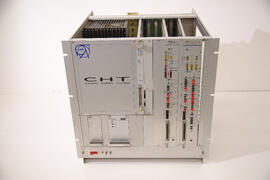
CHT, CERN HIPPI Testbox
CERN-OBJ-IT-116 · Unidad documental simple · 1990
Parte de Heritage Collection

To allow CERN to test and maintain HIPPI equipment (High Performance Parallel Interface), a powerful test falcility is required. A tester has been developed at Los Alamos National Laboratories [9,10]. The CERN HIPPI testbox allows testing of HIPPI equipment both inside and outside the specifications. This includes the possibility of deliberately introducing errors. The main features of this testbox are: Manual set-up Processor controlled set-up Possibilities for remote analysis Checking the HIPPI specifications Checking illegal conditions

IBM 5150 computer
CERN-OBJ-IT-118 · Unidad documental simple · 1981
Parte de Heritage Collection

IBM’s first personal computer arrived nearly 10 years after others companies, but instantly legitimized the market. IBM introduced its PC in 1981. IBM equipped the model 5150 with a cassette port for connecting a cassette drive. The first IBM PC ran on a 4.77 MHz Intel 8088 microprocessor. The PC came equipped with 16 kilobytes of memory, expandable to 256k. The PC came with one or two 160k floppy disk drives and an optional color monitor. The price tag started at $1,565, which would be nearly $4,000 (about €3,400) today.