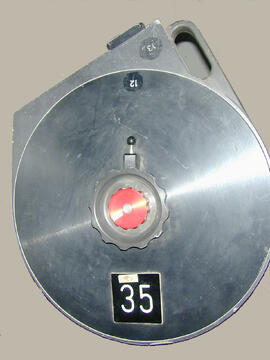
Part of the IBM computer that was used for physics simulations in preparation for experiments at LEP. When installed in 1985, it was considered to be very powerful. Nowadays, a PC can outperform it by a factor of ten.
Mostly used with scanning tables to record data coded on 6 holes.
Special terminals for the first computer ever used by CERN library.
Oracle StorageTek T10000T2 cartridge has total capacity of 5 TB. It is actually manufactured by Fuji Film, uses Barium Ferrite (BaFe) particles technology data store, but is also equipped with RFID chip. There is over 1 km of tape inside of the cartridge with 3584 data tracks and it supports over 25000 load/unload cycles. The archival life is estimated to be around 30 years and uncorrected bit error rate is 10-19. CERN however usually migrates data to newer technologies roughly every 5 years in order to keep the footprint under control.
This particular object was used up until 2012 in the Data Centre. It slots into one of the Disk Server trays. Hard disks were invented in the 1950s. They started as large disks up to 20 inches in diameter holding just a few megabytes (link is external). They were originally called "fixed disks" or "Winchesters" (a code name used for a popular IBM product). They later became known as "hard disks" to distinguish them from "floppy disks (link is external)." Hard disks have a hard platter that holds the magnetic medium, as opposed to the flexible plastic film found in tapes and floppies.
This model was a disk storage server used in the Data Centre up until 2012. Each tray contains a hard disk drive (see the 5TB hard disk drive on the main disk display section - this actually fits into one of the trays). There are 16 trays in all per server. There are hundreds of these servers mounted on racks in the Data Centre, as can be seen.
10BASE5 Thick Ethernet Cable, 10Mbit/sec. In the 1980s and early 1990's, Ethernet became more popular and provided a much faster data transmission rate. This cable is one of the first ethernet cables from 1983, a thick, bulky affair. Computers were attached via "Vampire Taps" which were connectors screwed straight through the shielding of the cable.
The first website at CERN - and in the world - was dedicated to the World Wide Web project itself and was hosted on Berners-Lee's NeXT computer. The website described the basic features of the web; how to access other people's documents and how to set up your own server. This NeXT machine - the original web server - is still at CERN. As part of the project to restore the first website, in 2013 CERN reinstated the world's first website to its original address.
The CDC 7600 has been created by Seymour Cray. It was designed to be compatible with the 6600, which allows for a substantial increase in performance. Furthermore the rise of new technologies has enabled this performance by reducing the minor cycle clock period from 100 ns to 27.5 ns (4 time faster). A very large machine, the 7600 had over 120 miles of hand-wired interconnections. It was the most powerful computer of its time. However, this speed caused a ground-loop problem causing intermittent faults, and eventually requiring all modules to be fitted with sheathed rubber bands. The CDC 7600 was replaced in 1983 by CRAY-1A.