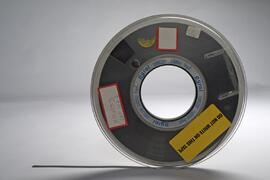
This magnetic disk was one of three which interfaced with various Control Data machines. This single platter came from a Control Data 7638 Disk Storage Subsystem and could contain up to 10MB - about the size of a few MP4's on your iPod.
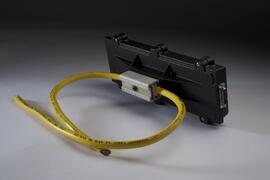
10BASE5 Thick Ethernet Cable, 10Mbit/sec. In the 1980s and early 1990's, Ethernet became more popular and provided a much faster data transmission rate. This cable is one of the first ethernet cables from 1983, a thick, bulky affair. Computers were attached via "Vampire Taps" which were connectors screwed straight through the shielding of the cable.
With arrival of CDC 6600 at CERN in January 1965, there came the first half-inch wide 7-tracks tape units with magnetic tapes at recording densities of 200, 556 and 800 bpi (bytes per inch).
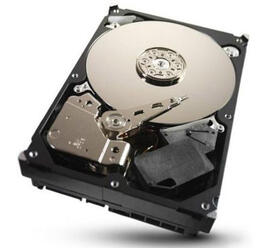
This particular object was used up until 2012 in the Data Centre. It slots into one of the Disk Server trays. Hard disks were invented in the 1950s. They started as large disks up to 20 inches in diameter holding just a few megabytes (link is external). They were originally called "fixed disks" or "Winchesters" (a code name used for a popular IBM product). They later became known as "hard disks" to distinguish them from "floppy disks (link is external)." Hard disks have a hard platter that holds the magnetic medium, as opposed to the flexible plastic film found in tapes and floppies.
Focusing magnet used for the AA (antiproton accumulator).Making an antiproton beam took a lot of time and effort. Firstly, protons were accelerated to an energy of 26 GeV in the PS and ejected onto a metal target. From the spray of emerging particles, a magnetic horn picked out 3.6 GeV antiprotons for injection into the AA through a wide-aperture focusing quadrupole magnet. For a million protons hitting the target, just one antiproton was captured, 'cooled' and accumulated. It took 3 days to make a beam of 3 x 10^11 - three hundred thousand million - antiprotons. About focusing magnets (quadrupoles): Quadrupole magnets are needed to focus the particle beams and squeeze them so that more particles collide when the beams cross. Particle beams are stored for about 10 hours in the LHC. During this time, the particles make four hundred million revolutions around the machine, travelling a distance equivalent to the diameter of the solar system.
On the inside of the cavity there is a layer of niobium. Operating at 4.2 degrees above absolute zero, the niobium is superconducting and carries an accelerating field of 6 million volts per metre with negligible losses. Each cavity has a surface of 6 m2. The niobium layer is only 1.2 microns thick, ten times thinner than a hair. Such a large area had never been coated to such a high accuracy. A speck of dust could ruin the performance of the whole cavity so the work had to be done in an extremely clean environment.
This is an accelerating cavity from LEP, with a layer of niobium on the inside. Operating at 4.2 degrees above absolute zero, the niobium is superconducting and carries an accelerating field of 6 million volts per metre with negligible losses. Each cavity has a surface of 6 m2. The niobium layer is only 1.2 microns thick, ten times thinner than a hair. Such a large area had never been coated to such a high accuracy. A speck of dust could ruin the performance of the whole cavity so the work had to be done in an extremely clean environment. These challenging requirements pushed European industry to new achievements. 256 of these cavities are now used in LEP to double the energy of the particle beams.
The AM29116 is a microprogrammed 16-bit processor.
This focusing horn was developed in 1992 by Remo Maccaferri, Jean Claude Schnuriger and Lubrano di Scampamorte and is still operating in the AD complex at CERN (as of 2017). This device could pulse at 400 KA (160 KA for the previous version). This enabled an antiproton collection ten times better than the old one. Firstly, protons were accelerated to an energy of 26 GeV/c and ejected onto a metal target. From the spray of emerging particles, the magnetic horn picked out 3.6 GeV antiprotons for injection into the AA through a wide-aperture focusing quadrupole magnet. For a million protons hitting the target, ten antiprotons were captured, 'cooled' and accumulated. It took 3 days to make a beam of 3 x 10^11 - three hundred thousand million - antiprotons. Originally magnetic focusing horns were developed by Simon van der Meer - see for example object AC-022 in this database.
Remo Maccaferri