This brass block was part of the CMS experiment. Its role was to slow down particles before their energy was measured. The Compact Muon Solenoid (CMS) experiment is one of two large general-purpose particle physics detectors built on the Large Hadron Collider (LHC).
Detectors and experimental techniques
106 Archival description results for Detectors and experimental techniques
This brass block was part of the CMS experiment. Its role was to slow down particles before their energy was measured. The Compact Muon Solenoid (CMS) experiment is one of two large general-purpose particle physics detectors built on the Large Hadron Collider (LHC).
The discovery of the Higgs boson by the ATLAS and CMS experiments was announced in CERN’s main auditorium in July 2012. Here, finally, was the missing piece in the standard model describing our universe. For some, it was the culmination of over 40 years’ work. This champagne bottle was drunk by members of CERN’s Theoretical physics group on the occasion.
CELESTA (CERN Latch-up Experiment Student Satellite) will be the first CERN-driven microsatellite, developed in collaboration with the University of Montpellier in the framework of a collaboration agreement defined and signed in 2015. The project, supported through the KT Fund, has two main objectives: one is developing and flying a space version of CERN radiation monitor (RadMon) coupled with a latch-up experiment; the second is showing that the space radiation environment of Low Earth Orbit can be reproduced in the CERN High energy AcceleRator Mixed field facility (CHARM). This would open the use for space system qualification activities, and provide a radiation monitor module for future missions.
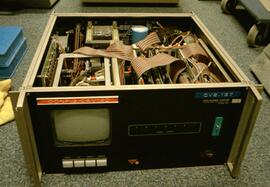
CAVIAR (CAMAC Video Autonomous Read-out), developed about 1980 at CERN in Geneva, was a multi-purpose microcomputer for the interactive development, in-line control and monitoring of experiments in high-energy physics. The CAVIAR machine was used in conjunction with a CAMAC system, consisting of a set of I/O modules assembled in a 19" crate. Some of the CAMAC-modules (for instance, analog-to-digital converters) would directly be connected to measuring devices, while another module would give access to a host (mainframe) computer through a high-speed link. The CAVIAR uses a Motorola 6800 microprocessor with 32 kB of solid-state RAM. In 29 kB EPROM the BAMBI (BASIC-like) interpreter is stored. Using the BAMBI graphics commands, graphs and histograms can be shown on the built-in miniature monitor screen. An alphanumeric terminal is connected to CAVIAR for programming and entering commands. The Super-CAVIAR (shown in the picture) is an enhanced version of CAVIAR with 64 kB RAM, 84 kB EPROM and other improvements.
The ATLAS transition radiation tracker is made of 300'000 straw tubes, up to 144cm long. Filled with a gas mixture and threaded with a wire, each straw is a complete mini-detector in its own right. An electric field is applied between the wire and the outside wall of the straw. As particles pass through, they collide with atoms in the gas, knocking out electrons. The avalanche of electrons is detected as an electrical signal on the wire in the centre. The tracker plays two important roles. Firstly, it makes more position measurements, giving more dots for the computers to join up to recreate the particle tracks. Also, together with the ATLAS calorimeters, it distinguishes between different types of particles depending on whether they emit radiation as they make the transition from the surrounding foil into the straws.