Detectors and experimental techniques

Elements area

Taxonomy

Code

Scope note(s)

    Source note(s)

      Display note(s)

        Hierarchical terms

        Detectors and experimental techniques

          Equivalent terms

          Detectors and experimental techniques

            Associated terms

            Detectors and experimental techniques

              106 Archival description results for Detectors and experimental techniques

              106 results directly related Exclude narrower terms
              Detector Unit
              CERN-OBJ-DE-091 · Item · 1960
              Part of Heritage Collection

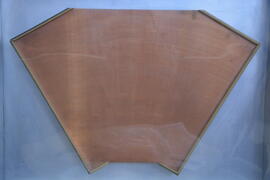
              Original detector unit of the Instituut voor Kernfysisch Onderzoek (IKO) BOL project. This detector unit shows that silicon detectors for nuclear physics particle detection were already developed and in use in the 1960's in Amsterdam. Also the idea of putting 'strips' onto the silicon for high spatial resolution of a particle's impact on the detector were implemented in the BOL project which used 64 of these detector units. The IKO BOL project with its silicon particle detectors was designed, built and operated from 1965 to roughly 1977. Detector Unit of the BOL project: These detectors, notably the ‘checkerboard detector’, were developed during the years 1964-1968 in Amsterdam, The Netherlands, by the Natuurkundig Laboratorium of the N.V. Philips Gloeilampen Fabrieken. This was done in close collaboration with the Instituut voor Kernfysisch Onderzoek (IKO) where the read-out electronics for their use in the BOL Project was developed and produced.

              Erik Bracke
              Detector Unit
              CERN-OBJ-DE-091 · Item · 1960
              Part of Heritage Collection Test

              Original detector unit of the Instituut voor Kernfysisch Onderzoek (IKO) BOL project. This detector unit shows that silicon detectors for nuclear physics particle detection were already developed and in use in the 1960's in Amsterdam. Also the idea of putting 'strips' onto the silicon for high spatial resolution of a particle's impact on the detector were implemented in the BOL project which used 64 of these detector units. The IKO BOL project with its silicon particle detectors was designed, built and operated from 1965 to roughly 1977. Detector Unit of the BOL project: These detectors, notably the ‘checkerboard detector’, were developed during the years 1964-1968 in Amsterdam, The Netherlands, by the Natuurkundig Laboratorium of the N.V. Philips Gloeilampen Fabrieken. This was done in close collaboration with the Instituut voor Kernfysisch Onderzoek (IKO) where the read-out electronics for their use in the BOL Project was developed and produced.

              Erik Bracke
              Crystal Detectors
              CERN-OBJ-DE-124 · Item
              Part of Heritage Collection Test

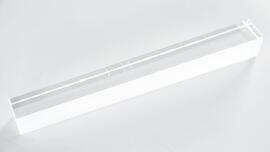
              The crystals used in CMS’s electromagnetic calorimeter may look like simple bricks of glass, but they are in fact mostly metal and are heavier than steel! Lead tungstate crystal with a touch of oxygen in this crystalline form is highly transparent and scintillates when electrons and photons pass through it. This means it produces light in proportion to the particle’s energy. CMS contains nearly 80’000 such crystals, each of which took two days to grow. This technology developed at CERN has applications in medical imaging, for example improving cancer diagnosis. The Compact Muon Solenoid (CMS) is a general-purpose detector at the Large Hadron Collider (LHC).

              Crystal Detectors
              CERN-OBJ-DE-124 · Item
              Part of Heritage Collection

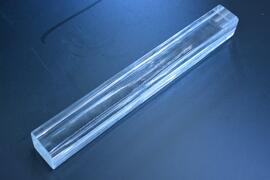
              The crystals used in CMS’s electromagnetic calorimeter may look like simple bricks of glass, but they are in fact mostly metal and are heavier than steel! Lead tungstate crystal with a touch of oxygen in this crystalline form is highly transparent and scintillates when electrons and photons pass through it. This means it produces light in proportion to the particle’s energy. CMS contains nearly 80’000 such crystals, each of which took two days to grow. This technology developed at CERN has applications in medical imaging, for example improving cancer diagnosis. The Compact Muon Solenoid (CMS) is a general-purpose detector at the Large Hadron Collider (LHC).

              CMS Crystals
              CERN-OBJ-DE-101 · Item
              Part of Heritage Collection Test

              The crystals used in CMS’s electromagnetic calorimeter may look like simple bricks of glass, but they are in fact mostly metal and are heavier than steel! Lead tungstate crystal with a touch of oxygen in this crystalline form is highly transparent and scintillates when electrons and photons pass through it. This means it produces light in proportion to the particle’s energy. CMS contains nearly 80’000 such crystals, each of which took two days to grow. This technology developed at CERN has applications in medical imaging, for example improving cancer diagnosis. The Compact Muon Solenoid (CMS) is a general-purpose detector at the Large Hadron Collider (LHC).

              CMS Crystals
              CERN-OBJ-DE-101 · Item
              Part of Heritage Collection

              The crystals used in CMS’s electromagnetic calorimeter may look like simple bricks of glass, but they are in fact mostly metal and are heavier than steel! Lead tungstate crystal with a touch of oxygen in this crystalline form is highly transparent and scintillates when electrons and photons pass through it. This means it produces light in proportion to the particle’s energy. CMS contains nearly 80’000 such crystals, each of which took two days to grow. This technology developed at CERN has applications in medical imaging, for example improving cancer diagnosis. The Compact Muon Solenoid (CMS) is a general-purpose detector at the Large Hadron Collider (LHC).