A good dozen different targets are available for ISOLDE, made of different materials and equipped with different kinds of ion-sources, according to the needs of the experiments. Each separator (GPS: general purpose; HRS: high resolution) has its own target. Because of the high radiation levels, robots effect the target changes, about 80 times per year. In the standard unit shown in picture _01, the target is the cylindrical object in the front. It contains uranium-carbide kept at a temperature of 2200 deg C, necessary for the isotopes to be able to escape. At either end, one sees the heater current leads, carrying 700 A. The Booster beam, some 3E13 protons per pulse, enters the target from left. The evaporated isotope atoms enter a hot-plasma ion source (the black object behind the target). The whole unit sits at 60 kV potential (pulsed in synchronism with the arrival of the Booster beam) which accelerates the ions (away from the viewer) towards one of the 2 separators.
Detectors and experimental techniques
106 Archival description results for Detectors and experimental techniques
106 results directly related
Exclude narrower terms
CERN-OBJ-DE-121
·
Item
Part of Heritage Collection Test
CERN-OBJ-DE-121
·
Item
Part of Heritage Collection
A good dozen different targets are available for ISOLDE, made of different materials and equipped with different kinds of ion-sources, according to the needs of the experiments. Each separator (GPS: general purpose; HRS: high resolution) has its own target. Because of the high radiation levels, robots effect the target changes, about 80 times per year. In the standard unit shown in picture _01, the target is the cylindrical object in the front. It contains uranium-carbide kept at a temperature of 2200 deg C, necessary for the isotopes to be able to escape. At either end, one sees the heater current leads, carrying 700 A. The Booster beam, some 3E13 protons per pulse, enters the target from left. The evaporated isotope atoms enter a hot-plasma ion source (the black object behind the target). The whole unit sits at 60 kV potential (pulsed in synchronism with the arrival of the Booster beam) which accelerates the ions (away from the viewer) towards one of the 2 separators.

CERN-OBJ-DE-112
·
Item
Part of Heritage Collection
The Gas Electron Multiplier (GEM) is a state-of-the-art particle detection technology utilized in the CMS experiment at CERN. It enhances the accuracy and resolution of muon measurements, playing a pivotal role in advancing our understanding of fundamental particle physics.
CERN-OBJ-DE-112
·
Item
Part of Heritage Collection Test
The Gas Electron Multiplier (GEM) is a state-of-the-art particle detection technology utilized in the CMS experiment at CERN. It enhances the accuracy and resolution of muon measurements, playing a pivotal role in advancing our understanding of fundamental particle physics.
CERN-OBJ-DE-119
·
Item
Part of Heritage Collection Test
An ionization chamber with fast timing properties was built at CERN for measuring fission cross-sections of minor actinides at the n_TOF neutron beam. The design of this chamber and of the front-end electronics was optimized to match the innovative features of the n_TOF facility, in particular the high instantaneous neutron flux and low background. Micromegas (Micro-MEsh Gaseous Structure) detectors are gas detectors consisting of a stack of one ionization and one proportional chamber. A micromesh separates the two communicating regions, where two different electric fields establish respectively a charge drift and a charge multiplication regime. The n_TOF facility at CERN provides a white neutron beam (from thermal up to GeV neutrons) for neutron induced cross section measurements.

CERN-OBJ-DE-119
·
Item
Part of Heritage Collection
An ionization chamber with fast timing properties was built at CERN for measuring fission cross-sections of minor actinides at the n_TOF neutron beam. The design of this chamber and of the front-end electronics was optimized to match the innovative features of the n_TOF facility, in particular the high instantaneous neutron flux and low background. Micromegas (Micro-MEsh Gaseous Structure) detectors are gas detectors consisting of a stack of one ionization and one proportional chamber. A micromesh separates the two communicating regions, where two different electric fields establish respectively a charge drift and a charge multiplication regime. The n_TOF facility at CERN provides a white neutron beam (from thermal up to GeV neutrons) for neutron induced cross section measurements.

CERN-OBJ-DE-077
·
Item
Part of Heritage Collection Test
Donated by B. Chaddaz.

CERN-OBJ-DE-077
·
Item
Part of Heritage Collection
Donated by B. Chaddaz.
CERN-OBJ-DE-076
·
Item
Part of Heritage Collection Test
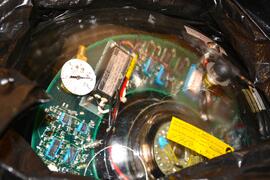
This object is one of the 256 other detectors of the DUMAND (Deep Underwater Muon And Neutrino Detection) experiment. The goal of the experiment was the construction of the first deep ocean high energy neutrino detector, to be placed at 4800 m depth in the Pacific Ocean off Keahole Point on the Big Island of Hawaii. A few years ago, a European conference with Cosmic experiments was organized at CERN as they were projects like DUMAND in Hawaii. Along with the conference, a temporary exhibition was organised as well. It was a collaboration of institutions from Germany, Japan, Switzerland and the U.S.A. CERN had borrowed equipment and objects from different institutes around the world, including this detector of the DUMAND experiment. Most of the equipment were sent back to the institutes, however this detector sphere was offered to a CERN member of the personnel.
dominique.bertola@cern.ch Dominique Bertola
CERN-OBJ-DE-076
·
Item
Part of Heritage Collection
This object is one of the 256 other detectors of the DUMAND (Deep Underwater Muon And Neutrino Detection) experiment. The goal of the experiment was the construction of the first deep ocean high energy neutrino detector, to be placed at 4800 m depth in the Pacific Ocean off Keahole Point on the Big Island of Hawaii. A few years ago, a European conference with Cosmic experiments was organized at CERN as they were projects like DUMAND in Hawaii. Along with the conference, a temporary exhibition was organised as well. It was a collaboration of institutions from Germany, Japan, Switzerland and the U.S.A. CERN had borrowed equipment and objects from different institutes around the world, including this detector of the DUMAND experiment. Most of the equipment were sent back to the institutes, however this detector sphere was offered to a CERN member of the personnel.
dominique.bertola@cern.ch Dominique Bertola