Detectors and experimental techniques

Elements area

Taxonomy

Code

Scope note(s)

    Source note(s)

      Display note(s)

        Hierarchical terms

        Detectors and experimental techniques

          Equivalent terms

          Detectors and experimental techniques

            Associated terms

            Detectors and experimental techniques

              106 Archival description results for Detectors and experimental techniques

              106 results directly related Exclude narrower terms
              CERN-OBJ-DE-116 · Item
              Part of Heritage Collection

              A half shell of the barrel CMS Pixel Phase-0 that was installed at the start-up of the Large Hadron Collider (2009-2016 in operation) and has been involved in the discovery of the Higgs boson.
              CERN-OBJ-DE-097 · Item
              Part of Heritage Collection Test

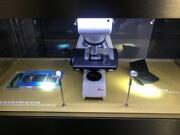
              Under the microscope you can see a pixel of silicon from a new generation of high-precision detectors under development for ALICE. The ALICE detector is designed for the periods when the LHC collides the nuclei of lead atoms rather than protons. These lead collisions produce extremely dense tangles of particle tracks and many short-lived particles. Precision is key! The new silicon detectors are extremely thin and can measure the passage of particles with a precision of 5 thousandth’s of a millimetre. The connections to the electronics are integrated into the silicon.

              CERN-OBJ-DE-097 · Item
              Part of Heritage Collection

              Under the microscope you can see a pixel of silicon from a new generation of high-precision detectors under development for ALICE. The ALICE detector is designed for the periods when the LHC collides the nuclei of lead atoms rather than protons. These lead collisions produce extremely dense tangles of particle tracks and many short-lived particles. Precision is key! The new silicon detectors are extremely thin and can measure the passage of particles with a precision of 5 thousandth’s of a millimetre. The connections to the electronics are integrated into the silicon.

              CERN-OBJ-DE-107 · Item
              Part of Heritage Collection Test

              This detector is part of the ALICE experiment's Time Projection Chamber (TPC). With incredible precision, the TPC records the thousands of tracks of charged particles spraying out from the collision, allowing each particle to be identified. In such a dense, electronics-filled environment, it is rare to find a relatively empty space - yet most of the TPC's 88m3 volume is filled with just gas, with read-out detectors, like this one located on the outer surface.

              CERN-OBJ-DE-107 · Item
              Part of Heritage Collection

              This detector is part of the ALICE experiment's Time Projection Chamber (TPC). With incredible precision, the TPC records the thousands of tracks of charged particles spraying out from the collision, allowing each particle to be identified. In such a dense, electronics-filled environment, it is rare to find a relatively empty space - yet most of the TPC's 88m3 volume is filled with just gas, with read-out detectors, like this one located on the outer surface.

              CERN-OBJ-DE-103 · Item
              Part of Heritage Collection Test

              The first layer of the ATLAS detector’s calorimeter is made of 8’200 lead plates and electrodes folded into an accordion shape and immersed in liquid argon. ATLAS (A Toroidal LHC ApparatuS) is the largest, general-purpose particle detector experiment at the Large Hadron Collider (LHC). As particles cross the folds and interact with the lead atoms, electrons and photons are ejected. There is a knock-on effect and as they continue on into the argon, a whole shower of secondary particles is produced. The electrodes register a signal that gives a measurement of the energy of the initial particle. As with most of the LHC detectors, the structural design challenge is to hold the heavy elements in place without affecting the measurements of the particles. Here, the layers of honeycomb spacer are designed to do just that. They separate the copper electrode layer from the lead and stainless steel absorber, allowing the liquid argon to flow freely in between.

              CERN-OBJ-DE-103 · Item
              Part of Heritage Collection

              The first layer of the ATLAS detector’s calorimeter is made of 8’200 lead plates and electrodes folded into an accordion shape and immersed in liquid argon. ATLAS (A Toroidal LHC ApparatuS) is the largest, general-purpose particle detector experiment at the Large Hadron Collider (LHC). As particles cross the folds and interact with the lead atoms, electrons and photons are ejected. There is a knock-on effect and as they continue on into the argon, a whole shower of secondary particles is produced. The electrodes register a signal that gives a measurement of the energy of the initial particle. As with most of the LHC detectors, the structural design challenge is to hold the heavy elements in place without affecting the measurements of the particles. Here, the layers of honeycomb spacer are designed to do just that. They separate the copper electrode layer from the lead and stainless steel absorber, allowing the liquid argon to flow freely in between.

              CERN-OBJ-DE-108 · Item
              Part of Heritage Collection Test

              The innermost layers of all four LHC detectors are made of silicon. This piece comes from the ATLAS detector where its job is to record the paths of the particles close to the collision. Here, hundreds of particles spray outwards and the silicon detectors must identify the exact points from which the particles originate and make an accurate measurement of the curvature of every particle track. Inside ATLAS, the first layer is made of 80 million silicon pixels, each smaller than a grain of sand. Surrounding the pixels are six million silicon strips, each about the thickness of a hair. The object on display here contains 1536 such silicon strips. Together, the layers of tracking detectors are like a giant 92 mega pixel camera taking a photo 40 million times every second.

              CERN-OBJ-DE-108 · Item
              Part of Heritage Collection

              The innermost layers of all four LHC detectors are made of silicon. This piece comes from the ATLAS detector where its job is to record the paths of the particles close to the collision. Here, hundreds of particles spray outwards and the silicon detectors must identify the exact points from which the particles originate and make an accurate measurement of the curvature of every particle track. Inside ATLAS, the first layer is made of 80 million silicon pixels, each smaller than a grain of sand. Surrounding the pixels are six million silicon strips, each about the thickness of a hair. The object on display here contains 1536 such silicon strips. Together, the layers of tracking detectors are like a giant 92 mega pixel camera taking a photo 40 million times every second.