This antimatter trap is used at the Antimatter decelerator to study atoms of antimatter. Electrically-charged antimatter can be trapped in this device, also called a Penning trap. The Penning trap requires an ultrahigh vacuum. Inside the trap, magnetic fields force the charged antiparticles to spiral around the magnetic field lines, and electric fields confine them along the magnetic axis. Even though at the beginning of the universe, antimatter has been produced in equal quantity with matter, it now seems to have completely disappeared.
Detectors and experimental techniques
53 Archival description results for Detectors and experimental techniques
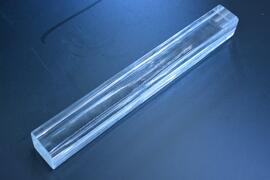
The Time-Of-Flight system of ALICE consists of 90 such modules, each containing 15 or 19 Multigap Resistive Plate Chamber (MRPC) strips. This detector is used for identification of charged particles. It measures with high precision (50 ps) the time of flight of charged particles and therefore their velocity. The curvature of the particle trajectory inside the magnetic field gives the momentum, thus the particle mass is calculated and the particle is identified The MRPC is a stack of resistive glass plates, separated from each other by nylon fishing line. The mass production of the chambers (~1600, covering a surface of 150 m2) was done at INFN Bologna, while the first prototypes were bult at CERN.
despoina.hatzifotiadou@cern.ch Despoina HatzifotiadouA wooden model of the ALEPH experiment and its cavern. ALEPH was one of 4 experiments at CERN's 27km Large Electron Positron collider (LEP) that ran from 1989 to 2000. During 11 years of research, LEP's experiments provided a detailed study of the electroweak interaction. Measurements performed at LEP also proved that there are three – and only three – generations of particles of matter. LEP was closed down on 2 November 2000 to make way for the construction of the Large Hadron Collider in the same tunnel. The cavern and detector are in separate locations - the cavern is stored at CERN and the detector is temporarily on display in Glasgow physics department. Both are available for loan.