Medipix is a family of read-out chips for particle imaging and detection developed by the Medipix Collaborations. The original concept is that it works like a camera, detecting and counting each individual particle hitting the pixels when its electronic shutter is open. This enables high-resolution, high-contrast, noise hit free images – making it unique for imaging applications. Hybrid pixel detector technology was initially developed to address the needs of particle tracking at the CERN LHC. The Medipix1 chip, which uses identical front-end circuitry to the Omega3 particle tracking chip, demonstrated the great potential for the technology outside of high-energy physics. To further develop this novel technology and take it into new scientific fields the Medipix2 Collaboration was started in 1999, the Medipix3 collaboration in 2005 and finally the Medipix4 collaboration in 2016.
Detectors and experimental techniques
106 Archival description results for Detectors and experimental techniques
106 results directly related
Exclude narrower terms
CERN-OBJ-DE-115
·
Item
Part of Heritage Collection Test
CERN-OBJ-DE-115
·
Item
Part of Heritage Collection
Medipix is a family of read-out chips for particle imaging and detection developed by the Medipix Collaborations. The original concept is that it works like a camera, detecting and counting each individual particle hitting the pixels when its electronic shutter is open. This enables high-resolution, high-contrast, noise hit free images – making it unique for imaging applications. Hybrid pixel detector technology was initially developed to address the needs of particle tracking at the CERN LHC. The Medipix1 chip, which uses identical front-end circuitry to the Omega3 particle tracking chip, demonstrated the great potential for the technology outside of high-energy physics. To further develop this novel technology and take it into new scientific fields the Medipix2 Collaboration was started in 1999, the Medipix3 collaboration in 2005 and finally the Medipix4 collaboration in 2016.
CERN-OBJ-DE-123
·
Item
Part of Heritage Collection Test
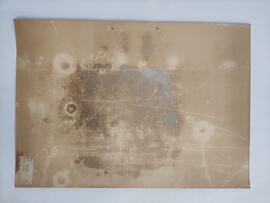
Particles coming from the universe are crossing the earth all the time – they are harmless but invisible to us. Cloud Chambers are detectors which make the tracks of the particles visible. Some decades ago these detectors were used at CERN in the first particle physics experiments.
CERN-OBJ-DE-123
·
Item
Part of Heritage Collection
Particles coming from the universe are crossing the earth all the time – they are harmless but invisible to us. Cloud Chambers are detectors which make the tracks of the particles visible. Some decades ago these detectors were used at CERN in the first particle physics experiments.
CERN-OBJ-DE-085
·
Item
·
1980
Part of Heritage Collection Test
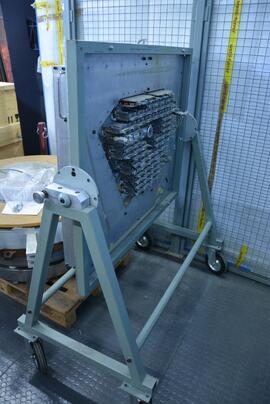
This is a prototype endplate piece constructed during R&D for the ALEPH Time Projection Chamber (TPC). ALEPH was one of 4 experiments at CERN's 27km Large Electron Positron collider (LEP) that ran from 1989 to 2000. ALEPH's TPC was a large-volume tracking chamber, 4.4 metres long and 3.6 metres in diameter - the largest TPC in existance at the time. This object is one of the endplates of a “Kind” sector, the smallest of the three types of sectors. The patterns etched into the copper form the cathode pads that measured particle track coordinates in the r-phi direction. It included a laser calibration system, a gating system to prevent space charge buildup, and a new radial pad geometry to improve resolution. the ALEPH TPC allowed for precise momentum measurements of the high-momentum particles from W and Z decays. The following institutes participated: CERN, Athens, Glasgow, Mainz, MPI Munich, INFN-Pisa, INFN-Trieste, Wisconsin.
CERN-OBJ-DE-085
·
Item
·
1980
Part of Heritage Collection
This is a prototype endplate piece constructed during R&D for the ALEPH Time Projection Chamber (TPC). ALEPH was one of 4 experiments at CERN's 27km Large Electron Positron collider (LEP) that ran from 1989 to 2000. ALEPH's TPC was a large-volume tracking chamber, 4.4 metres long and 3.6 metres in diameter - the largest TPC in existance at the time. This object is one of the endplates of a “Kind” sector, the smallest of the three types of sectors. The patterns etched into the copper form the cathode pads that measured particle track coordinates in the r-phi direction. It included a laser calibration system, a gating system to prevent space charge buildup, and a new radial pad geometry to improve resolution. the ALEPH TPC allowed for precise momentum measurements of the high-momentum particles from W and Z decays. The following institutes participated: CERN, Athens, Glasgow, Mainz, MPI Munich, INFN-Pisa, INFN-Trieste, Wisconsin.
CERN-OBJ-DE-113
·
Item
·
2017
Part of Heritage Collection Test
An alternative method of detecting particles spraying out of collisions in the inner regions of experiments uses scintillating fibres.

CERN-OBJ-DE-113
·
Item
·
2017
Part of Heritage Collection
An alternative method of detecting particles spraying out of collisions in the inner regions of experiments uses scintillating fibres.
CERN-OBJ-DE-072
·
Item
Part of Heritage Collection Test
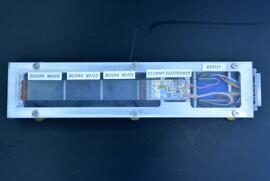
Used in LEP experiment. It is a element of the first OPAL silicon strip vertex detector.
CERN-OBJ-DE-072
·
Item
Part of Heritage Collection
Used in LEP experiment. It is a element of the first OPAL silicon strip vertex detector.