Detectors and experimental techniques

Elements area

Taxonomy

Code

Scope note(s)

    Source note(s)

      Display note(s)

        Hierarchical terms

        Detectors and experimental techniques

          Equivalent terms

          Detectors and experimental techniques

            Associated terms

            Detectors and experimental techniques

              53 Archival description results for Detectors and experimental techniques

              53 results directly related Exclude narrower terms
              Heritage collection CERN-OBJ-CERN-OBJ-DE-107 · Item
              Part of Heritage Collection Test

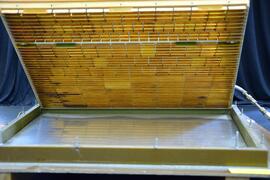
              This detector is part of the ALICE experiment's Time Projection Chamber (TPC). With incredible precision, the TPC records the thousands of tracks of charged particles spraying out from the collision, allowing each particle to be identified. In such a dense, electronics-filled environment, it is rare to find a relatively empty space - yet most of the TPC's 88m3 volume is filled with just gas, with read-out detectors, like this one located on the outer surface.

              Heritage collection CERN-OBJ-CERN-OBJ-DE-097 · Item
              Part of Heritage Collection Test

              Under the microscope you can see a pixel of silicon from a new generation of high-precision detectors under development for ALICE. The ALICE detector is designed for the periods when the LHC collides the nuclei of lead atoms rather than protons. These lead collisions produce extremely dense tangles of particle tracks and many short-lived particles. Precision is key! The new silicon detectors are extremely thin and can measure the passage of particles with a precision of 5 thousandth’s of a millimetre. The connections to the electronics are integrated into the silicon.

              Heritage collection CERN-OBJ-CERN-OBJ-DE-116 · Item
              Part of Heritage Collection Test

              A half shell of the barrel CMS Pixel Phase-0 that was installed at the start-up of the Large Hadron Collider (2009-2016 in operation) and has been involved in the discovery of the Higgs boson.

              Silicon detector
              Heritage collection CERN-OBJ-CERN-OBJ-DE-072 · Item
              Part of Heritage Collection Test

              Used in LEP experiment. It is a element of the first OPAL silicon strip vertex detector.

              Scintillating Fibres
              Heritage collection CERN-OBJ-CERN-OBJ-DE-113 · Item · 2017
              Part of Heritage Collection Test

              An alternative method of detecting particles spraying out of collisions in the inner regions of experiments uses scintillating fibres.

              Heritage collection CERN-OBJ-CERN-OBJ-DE-085 · Item · 1980
              Part of Heritage Collection Test

              This is a prototype endplate piece constructed during R&D for the ALEPH Time Projection Chamber (TPC). ALEPH was one of 4 experiments at CERN's 27km Large Electron Positron collider (LEP) that ran from 1989 to 2000. ALEPH's TPC was a large-volume tracking chamber, 4.4 metres long and 3.6 metres in diameter - the largest TPC in existance at the time. This object is one of the endplates of a “Kind” sector, the smallest of the three types of sectors. The patterns etched into the copper form the cathode pads that measured particle track coordinates in the r-phi direction. It included a laser calibration system, a gating system to prevent space charge buildup, and a new radial pad geometry to improve resolution. the ALEPH TPC allowed for precise momentum measurements of the high-momentum particles from W and Z decays. The following institutes participated: CERN, Athens, Glasgow, Mainz, MPI Munich, INFN-Pisa, INFN-Trieste, Wisconsin.

              Heritage collection CERN-OBJ-CERN-OBJ-DE-123 · Item
              Part of Heritage Collection Test

              Particles coming from the universe are crossing the earth all the time – they are harmless but invisible to us. Cloud Chambers are detectors which make the tracks of the particles visible. Some decades ago these detectors were used at CERN in the first particle physics experiments.

              Medipix Chip
              Heritage collection CERN-OBJ-CERN-OBJ-DE-115 · Item
              Part of Heritage Collection Test

              Medipix is a family of read-out chips for particle imaging and detection developed by the Medipix Collaborations. The original concept is that it works like a camera, detecting and counting each individual particle hitting the pixels when its electronic shutter is open. This enables high-resolution, high-contrast, noise hit free images – making it unique for imaging applications. Hybrid pixel detector technology was initially developed to address the needs of particle tracking at the CERN LHC. The Medipix1 chip, which uses identical front-end circuitry to the Omega3 particle tracking chip, demonstrated the great potential for the technology outside of high-energy physics. To further develop this novel technology and take it into new scientific fields the Medipix2 Collaboration was started in 1999, the Medipix3 collaboration in 2005 and finally the Medipix4 collaboration in 2016.

              LHCb scintillating tiles
              Heritage collection CERN-OBJ-CERN-OBJ-DE-104 · Item
              Part of Heritage Collection Test

              The electromagnetic calorimeter used in LHCb is a sandwich of lead plates and scintillating tiles. Incoming particles interact with the lead, creating a shower of new particles. This shower goes on to interact with the plastic tiles where its energy is transformed into tiny flashes of light, called scintillations. All this light is then collected in optical fibres which transport it to a photomultiplier tube that converts the light signal into a pulse of electrical current. The resulting signal reveals the energy of the original particle. 3300 such modules combine to make up the first layer of LHCb calorimeters.

              ISOLDE target prototype
              Heritage collection CERN-OBJ-CERN-OBJ-DE-118 · Item
              Part of Heritage Collection Test

              Radioactive nuclei are produced at the ISOLDE facility by shooting a high-energy beam of protons on a thick target. By studying some of these nuclei, physicists are improving the knowledge of nucleosynthesis, the process through which stars produce chemical elements. This is a prototype that was developed for the CERN Open Days, in 2019.