Detectors and experimental techniques
53 Archivistische beschrijving results for Detectors and experimental techniques
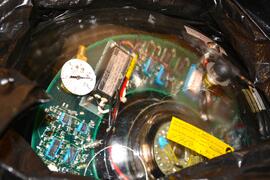
Original detector unit of the Instituut voor Kernfysisch Onderzoek (IKO) BOL project. This detector unit shows that silicon detectors for nuclear physics particle detection were already developed and in use in the 1960's in Amsterdam. Also the idea of putting 'strips' onto the silicon for high spatial resolution of a particle's impact on the detector were implemented in the BOL project which used 64 of these detector units. The IKO BOL project with its silicon particle detectors was designed, built and operated from 1965 to roughly 1977. Detector Unit of the BOL project: These detectors, notably the ‘checkerboard detector’, were developed during the years 1964-1968 in Amsterdam, The Netherlands, by the Natuurkundig Laboratorium of the N.V. Philips Gloeilampen Fabrieken. This was done in close collaboration with the Instituut voor Kernfysisch Onderzoek (IKO) where the read-out electronics for their use in the BOL Project was developed and produced.
Zonder titelOne of the building blocks of the CMS Silicon Tracker: a part of the detector that reconstructs the trajectories of charged particles emerging from the proton-proton collisions. A lightweight structure, made mostly of carbon fibre, supports silicon detectors and their readout electronics. These detectors generate an electrical pulse when they are traversed by a charged particle, and they are segmented into fine strips (in this case the strips are 180 microns wide, about the size of a human hair) that collect those pulses, such that the position of the strip provides a coordinate on the particle trajectory. In this “rod” silicon detectors are arranged in back-to-back pairs, where the two detectors of each pair have the strips oriented at an angle, such that the crossing point of the strips provides a two-dimensional coordinate in the rod plane. Three pairs of detectors are mounted on each side of the rod structure, to fully cover its surface. In the Tracker, rods are arranged to form cylindrical layers in the central “barrel” region.
Under the microscope you can see a pixel of silicon from a new generation of high-precision detectors under development for ALICE. The ALICE detector is designed for the periods when the LHC collides the nuclei of lead atoms rather than protons. These lead collisions produce extremely dense tangles of particle tracks and many short-lived particles. Precision is key! The new silicon detectors are extremely thin and can measure the passage of particles with a precision of 5 thousandth’s of a millimetre. The connections to the electronics are integrated into the silicon.
Each of these straws is a complete mini–detector in its own right. Every one is filled with a gas mixture and threaded with a wire. Imagine assembling 300’000 fragile drinking straws up to 144 cm long, with no bends or kinks allowed! This layer of tracker plays two important roles. Firstly, it makes more position measurements, giving more dots for the computers to join up to recreate the particle tracks. Then it also helps distinguish between different types of particles depending on whether they emit radiation as they make the transition from the surrounding foil into the straws. An electric field is applied between the wire and the outside wall of the straw. As particles pass through, they collide with atoms in the gas, knocking out electrons. The avalanche of electrons is detected as an electrical signal on the wire in the centre.
LHCb measures muons using gold plated tungsten wires stretched over read-out pads. A high voltage is applied across the wires and pads and the set-up is bathed in a gas mixture. Passing muons interact with the gas, knocking out electrons from its atoms in a process called ionization. Both the ionized atoms and the electrons then drift in the electric field. This movement creates an electric signal in the wires and pads that is used to identify where the muon has passed. In total, the LHCb muon detectors contain about 2 million wires and are capable of making measurements 40 million times a second – every time the particle beams collide.
The innermost layers of all four LHC detectors are made of silicon. This piece comes from the ATLAS detector where its job is to record the paths of the particles close to the collision. Here, hundreds of particles spray outwards and the silicon detectors must identify the exact points from which the particles originate and make an accurate measurement of the curvature of every particle track. Inside ATLAS, the first layer is made of 80 million silicon pixels, each smaller than a grain of sand. Surrounding the pixels are six million silicon strips, each about the thickness of a hair. The object on display here contains 1536 such silicon strips. Together, the layers of tracking detectors are like a giant 92 mega pixel camera taking a photo 40 million times every second.
The ATLAS transition radiation tracker is made of 300'000 straw tubes, up to 144cm long. Filled with a gas mixture and threaded with a wire, each straw is a complete mini-detector in its own right. An electric field is applied between the wire and the outside wall of the straw. As particles pass through, they collide with atoms in the gas, knocking out electrons. The avalanche of electrons is detected as an electrical signal on the wire in the centre. The tracker plays two important roles. Firstly, it makes more position measurements, giving more dots for the computers to join up to recreate the particle tracks. Also, together with the ATLAS calorimeters, it distinguishes between different types of particles depending on whether they emit radiation as they make the transition from the surrounding foil into the straws.
Medipix is a family of read-out chips for particle imaging and detection developed by the Medipix Collaborations. The original concept is that it works like a camera, detecting and counting each individual particle hitting the pixels when its electronic shutter is open. This enables high-resolution, high-contrast, noise hit free images – making it unique for imaging applications. Hybrid pixel detector technology was initially developed to address the needs of particle tracking at the CERN LHC. The Medipix1 chip, which uses identical front-end circuitry to the Omega3 particle tracking chip, demonstrated the great potential for the technology outside of high-energy physics. To further develop this novel technology and take it into new scientific fields the Medipix2 Collaboration was started in 1999, the Medipix3 collaboration in 2005 and finally the Medipix4 collaboration in 2016.
The ATLAS Muon Drift Tube Chamber is a precision tracking detector used to identify and track muons in the ATLAS experiment at CERN. It's crucial for the study of the Higgs boson and other fundamental particles, helping researchers understand the basic forces and constituents of the universe.