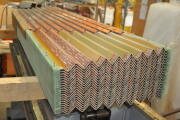
The first layer of the ATLAS detector’s calorimeter is made of 8’200 lead plates and electrodes folded into an accordion shape and immersed in liquid argon. ATLAS (A Toroidal LHC ApparatuS) is the largest, general-purpose particle detector experiment at the Large Hadron Collider (LHC). As particles cross the folds and interact with the lead atoms, electrons and photons are ejected. There is a knock-on effect and as they continue on into the argon, a whole shower of secondary particles is produced. The electrodes register a signal that gives a measurement of the energy of the initial particle. As with most of the LHC detectors, the structural design challenge is to hold the heavy elements in place without affecting the measurements of the particles. Here, the layers of honeycomb spacer are designed to do just that. They separate the copper electrode layer from the lead and stainless steel absorber, allowing the liquid argon to flow freely in between.
Detectors and experimental techniques
106 Descripción archivística resultados para Detectors and experimental techniques
106 resultados directamente relacionados
Excluir términos relacionados
CERN-OBJ-DE-103
·
Unidad documental simple
Parte de Heritage Collection Test
CERN-OBJ-DE-118
·
Unidad documental simple
Parte de Heritage Collection Test
Radioactive nuclei are produced at the ISOLDE facility by shooting a high-energy beam of protons on a thick target. By studying some of these nuclei, physicists are improving the knowledge of nucleosynthesis, the process through which stars produce chemical elements. This is a prototype that was developed for the CERN Open Days, in 2019.
CERN-OBJ-DE-119
·
Unidad documental simple
Parte de Heritage Collection Test
An ionization chamber with fast timing properties was built at CERN for measuring fission cross-sections of minor actinides at the n_TOF neutron beam. The design of this chamber and of the front-end electronics was optimized to match the innovative features of the n_TOF facility, in particular the high instantaneous neutron flux and low background. Micromegas (Micro-MEsh Gaseous Structure) detectors are gas detectors consisting of a stack of one ionization and one proportional chamber. A micromesh separates the two communicating regions, where two different electric fields establish respectively a charge drift and a charge multiplication regime. The n_TOF facility at CERN provides a white neutron beam (from thermal up to GeV neutrons) for neutron induced cross section measurements.
CERN-OBJ-DE-113
·
Unidad documental simple
·
2017
Parte de Heritage Collection Test
An alternative method of detecting particles spraying out of collisions in the inner regions of experiments uses scintillating fibres.
CERN-OBJ-DE-121
·
Unidad documental simple
Parte de Heritage Collection Test
A good dozen different targets are available for ISOLDE, made of different materials and equipped with different kinds of ion-sources, according to the needs of the experiments. Each separator (GPS: general purpose; HRS: high resolution) has its own target. Because of the high radiation levels, robots effect the target changes, about 80 times per year. In the standard unit shown in picture _01, the target is the cylindrical object in the front. It contains uranium-carbide kept at a temperature of 2200 deg C, necessary for the isotopes to be able to escape. At either end, one sees the heater current leads, carrying 700 A. The Booster beam, some 3E13 protons per pulse, enters the target from left. The evaporated isotope atoms enter a hot-plasma ion source (the black object behind the target). The whole unit sits at 60 kV potential (pulsed in synchronism with the arrival of the Booster beam) which accelerates the ions (away from the viewer) towards one of the 2 separators.
CERN-OBJ-DE-123
·
Unidad documental simple
Parte de Heritage Collection Test
Particles coming from the universe are crossing the earth all the time – they are harmless but invisible to us. Cloud Chambers are detectors which make the tracks of the particles visible. Some decades ago these detectors were used at CERN in the first particle physics experiments.
CERN-OBJ-DE-125
·
Unidad documental simple
Parte de Heritage Collection Test
The CMS (Compact Muon Solenoid) Tile Calorimeter is a pivotal component of the CMS detector, which is one of the major experiments at the Large Hadron Collider (LHC) at CERN. Designed to measure the energy of particles, the calorimeter plays an essential role in the study of high-energy physics.
CERN-OBJ-DE-079
·
Unidad documental simple
·
1990
Parte de Heritage Collection
This module was built and tested with beam to validate the ATLAS electromagnetic calorimeter design. One original design feature is the folding. 10 000 lead plates and electrodes are folded into an accordion shape and immersed in liquid argon. As they cross the folds, particles are slowed down by the lead. As they collide with the lead atoms, electrons and photons are ejected. There is a knock-on effect and as they continue on into the argon, a whole shower is produced. The electrodes collect up all the electrons and this signal gives a measurement of the energy of the initial particle. This 2 m long module dates back to the first detector studies for the LHC in the 1990’s. It was built by the R&D collaboration RD-3 to evaluate the performances of liquid argon calorimetry for the physics programme - the search for the Higgs boson decays into two photons, in particular. After the choice of that technology by the ATLAS collaboration, the design of its elements were reassessed in view of production and a new module was tested in the CERN beam lines, leading to the Technical Design Report in 1996.
Sin título
CERN-OBJ-DE-073
·
Unidad documental simple
Parte de Heritage Collection
Muon detectors from the outer layer of the ATLAS experiment at the Large Hadron Collider. Over a million individual detectors combine to make up the outer layer of ATLAS. All of this is exclusively to track the muons, the only detectable particles to make it out so far from the collision point. How the muon’s path curves in the magnetic field depends on how fast it is travelling. A fast muon curves only a very little, a slower one curves a lot. Together with the calorimeters, the muon detectors play an essential role in deciding which collisions to store and which to ignore. Certain signals from muons are a sure sign of exciting discoveries. To make sure the data from these collisions is not lost, some of the muon detectors react very quickly and trigger the electronics to record. The other detectors take a little longer, but are much more precise. Their job is to measure exactly where the muons have passed, calculating the curvature of their tracks in the magnetic field to the nearest five hundredths of a millimetre. Even these precision detectors are not exactly sluggish – they react within a millionth of a second. Such a fast response is essential when new collisions are occurring in the centre of ATLAS 40 million times every second! This muon detector is a drift tube - an aluminium tube with a wall thickness of some 1/10 mm that is filled with a special gas mixture. Inside the tube there is a wire that is tightened all over the length of the tube and fixed at the end caps. Particles (or ionizing radiation) that enter the tube ionize the gas molecules and liberate electrons. Since there is a high voltage between the wire and the tube wall, the released negatively charged electrons move towards the wire in the centre of the tube. On their way to the central wire, the moving electrons induce an electric signal that can be amplified and registered by further electronics.

CERN-OBJ-DE-081
·
Unidad documental simple
Parte de Heritage Collection