Détecteurs et techniques expérimentales

Zone des éléments

Référentiel

Code

Note(s) sur la portée et contenu

    Note(s) sur la source

      Note(s) d'affichage

        Termes hiérarchiques

        Détecteurs et techniques expérimentales

          Termes équivalents

          Détecteurs et techniques expérimentales

            Termes associés

            Détecteurs et techniques expérimentales

              2 Description archivistique résultats pour Détecteurs et techniques expérimentales

              2 résultats directement liés Exclure les termes spécifiques
              Heritage collection CERN-OBJ-DE-CERN-OBJ-DE-098 · Dossier · [sans date]
              Fait partie de CERN Detectors

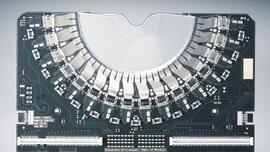
              42 modules like this one surround the collision point inside the LHCb detector. Their role is to measure the tracks of short-lived particles spraying out from the collision and to pinpoint the exact spots where they decay into secondary particles. Some exist for just trillionths of a second before decaying! The silicon modules operate so close to the collision point, they can only be moved into position once the circling particle beams are at their most focused. Otherwise, peripheral particles on the outside of the finer-than-a-hair beam would bore a hole right through them.

              Sans titre
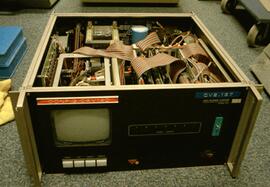
              CAVIAR Physics Microcomputer
              Heritage collection CERN-OBJ-DE-CERN-OBJ-DE-114 · Dossier
              Fait partie de CERN Detectors

              CAVIAR (CAMAC Video Autonomous Read-out), developed about 1980 at CERN in Geneva, was a multi-purpose microcomputer for the interactive development, in-line control and monitoring of experiments in high-energy physics. The CAVIAR machine was used in conjunction with a CAMAC system, consisting of a set of I/O modules assembled in a 19" crate. Some of the CAMAC-modules (for instance, analog-to-digital converters) would directly be connected to measuring devices, while another module would give access to a host (mainframe) computer through a high-speed link. The CAVIAR uses a Motorola 6800 microprocessor with 32 kB of solid-state RAM. In 29 kB EPROM the BAMBI (BASIC-like) interpreter is stored. Using the BAMBI graphics commands, graphs and histograms can be shown on the built-in miniature monitor screen. An alphanumeric terminal is connected to CAVIAR for programming and entering commands. The Super-CAVIAR (shown in the picture) is an enhanced version of CAVIAR with 64 kB RAM, 84 kB EPROM and other improvements.

              Sans titre