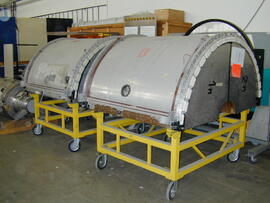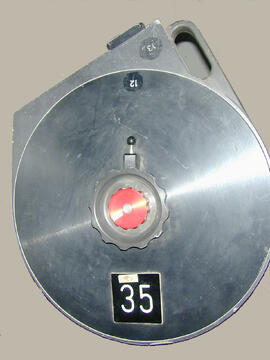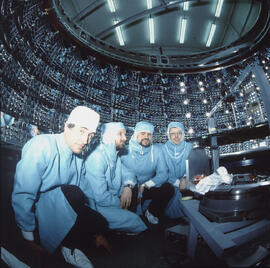
DELPHI was one of the four experiments installed at the LEP particle accelerator from 1989 - 2000. This is a piece of the Barrel Ring Imaging Cherenkov detector which was used to identify particles in DELPHI.It measured the Cherenkov light emitted when particles travelled faster than the speed of light through the material of the detector. The photo shows the complete Cherenkov detector.
Detector
196 Descripción archivística resultados para Detector
OPAL was one of the four experiments installed at the LEP particle accelerator from 1989 - 2000. The Silicon Tungsten Luminometer was part of OPAL's calorimeter which was used to measure the energy of particles. Most particles end their journey in calorimeters. These detectors measure the energy deposited when particles are slowed down and stopped.
The module was used as part of the muon identification system on the barrel of the DELPHI detector at LEP, and was in active use from 1989 to 2000. The module consists of 7 individual muons chambers arranged in 2 layers. Chambers in the upper layer are staggered by half a chamber width with respect to the lower layer. Each individual chamber is a drift chamber consisting of an anode wire, 47 microns in diameter, and a wrapped copper delay line. Each chamber provided 3 signal for each muon passing through the chamber, from which a 3D space-point could be reconstructed.
Sin títuloOPAL was one of the 4 experiments installed at the LEP particle accelerator from 1989 to 2000. This is a slice of the outermost layer of OPAL : the muon chambers. This outside layer detects particles which are not stopped by the previous layers. These are mostly muons.
Two wire chambers made originally for the R807 Experiment at CERN's Intersecting Storage Rings. In 1986 they were used for the PS 201 experiment (Obelix Experiment) at LEAR, the Low Energy Antiproton Ring. The group of researchers from Turin, using the chambers at that time, changed the acquisition system using for the first time 8 bit (10 bit non linear) analog to digital conversion for incoming signals from the chambers. The acquisition system was controlled by 54 CPU and 80 digital signal processors. The power required for all the electronics was 40 kW. For the period, this system was one of the most powerful on-line apparatus in the world. The Obelix Experiment was closed in 1996. To find more about how a wire chamber works, see the description for object CERN-OBJ-DE-038.
When you look through the glass at a picture behind, the picture appears raised up because light is slowed down in the dense glass. It is this density (4.06 gcm-3) that makes lead glass attractive to physicists. The refractive index of the glass is 1.708 at 400nm (violet light), meaning that light travels in the glass at about 58% its normal speed. At CERN, the OPAL detector uses some 12000 blocks of glass like this to measure particle energies.
Sin título<2> full boxes of light guides. Light guides like this are used to carry signals to the electronics for recording.
This is a calorimeter, a detector which measures the energy of particles. When in use, it is filled with liquid krypton at -152°C. Electrons and photons passing through interact with the krypton, creating a shower of charged particles which are collected on the copper ribbons. The ribbons are aligned to an accuracy of a tenth of a millimetre. The folding at each end allows them to be kept absolutely flat. Each shower of particles also creates a signal in scintillating material embedded in the support disks. These flashes of light are transmitted to electronics by the optical fibres along the side of the detector. They give the time at which the interaction occurred. The photo shows the calorimeter at NA48, a CERN experiment which is trying to understand the lack of anti-matter in the Universe today.
Before the days of electronic detectors, visual techniques were used to detect particles, using detectors such as spark chambers and bubble chambers. This plexiglass lens was used to focus the image of tracks so they could be photographed.
3 bubble chamber film rolls from the 2m bubble chamber.