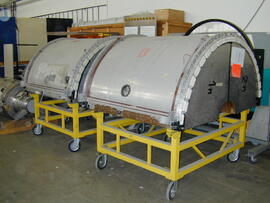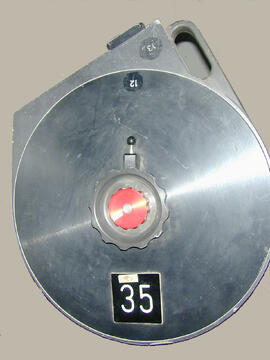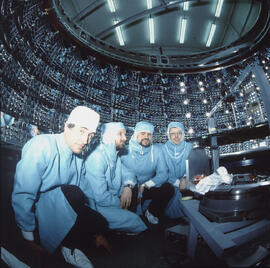
DELPHI was one of the four experiments installed at the LEP particle accelerator from 1989 - 2000. This is a piece of the Barrel Ring Imaging Cherenkov detector which was used to identify particles in DELPHI.It measured the Cherenkov light emitted when particles travelled faster than the speed of light through the material of the detector. The photo shows the complete Cherenkov detector.
Detector
261 Archivistische beschrijving results for Detector
OPAL was one of the four experiments installed at the LEP particle accelerator from 1989 - 2000. The Silicon Tungsten Luminometer was part of OPAL's calorimeter which was used to measure the energy of particles. Most particles end their journey in calorimeters. These detectors measure the energy deposited when particles are slowed down and stopped.
The module was used as part of the muon identification system on the barrel of the DELPHI detector at LEP, and was in active use from 1989 to 2000. The module consists of 7 individual muons chambers arranged in 2 layers. Chambers in the upper layer are staggered by half a chamber width with respect to the lower layer. Each individual chamber is a drift chamber consisting of an anode wire, 47 microns in diameter, and a wrapped copper delay line. Each chamber provided 3 signal for each muon passing through the chamber, from which a 3D space-point could be reconstructed.
Zonder titelOPAL was one of the 4 experiments installed at the LEP particle accelerator from 1989 to 2000. This is a slice of the outermost layer of OPAL : the muon chambers. This outside layer detects particles which are not stopped by the previous layers. These are mostly muons.
Two wire chambers made originally for the R807 Experiment at CERN's Intersecting Storage Rings. In 1986 they were used for the PS 201 experiment (Obelix Experiment) at LEAR, the Low Energy Antiproton Ring. The group of researchers from Turin, using the chambers at that time, changed the acquisition system using for the first time 8 bit (10 bit non linear) analog to digital conversion for incoming signals from the chambers. The acquisition system was controlled by 54 CPU and 80 digital signal processors. The power required for all the electronics was 40 kW. For the period, this system was one of the most powerful on-line apparatus in the world. The Obelix Experiment was closed in 1996. To find more about how a wire chamber works, see the description for object CERN-OBJ-DE-038.
Flash tube used in Gargamelle. Gargamelle was the name given to a big bubble chamber built at the Saclay Laboratory in France during the late 1960s. It was designed principally for the detection at CERN of the elusive particles called neutrinos.Gargamelle is on display at CERN in the Microcosm garden.
About 16 000 Micro Strip Gas Chambers like this one will be used in the CMS tracking detector. They will measure the tracks of charged particles to a hundredth of a millimetre precision in the region near the collision point where the density of particles is very high. Each chamber is filled with a gas mixture of argon and dimethyl ether. Charged particles passing through ionise the gas, knocking out electrons which are collected on the aluminium strips visible under the microscope. Such detectors are being used in radiography. They give higher resolution imaging and reduce the required dose of radiation.
3 bubble chamber film rolls from the 2m bubble chamber.
Wire chamber