Detector

Zone des éléments

Référentiel

Code

Note(s) sur la portée et contenu

    Note(s) sur la source

      Note(s) d'affichage

        Termes hiérarchiques

        Detector

          Termes équivalents

          Detector

            Termes associés

            Detector

              196 Description archivistique résultats pour Detector

              196 résultats directement liés Exclure les termes spécifiques
              bubble chamber lens
              CERN-OBJ-DE-031 · Pièce
              Fait partie de Heritage Collection Test

              Was used in a PS experiment. Before the days of electronic detectors, visual techniques were used to detect particles, using detectors such as spark chambers and bubble chambers. This plexiglass lens was used to focus the image of tracks so they could be photographed.

              Sans titre
              wire chamber
              CERN-OBJ-DE-039 · Pièce
              Fait partie de Heritage Collection Test

              Proportional multi-wire chamber. Multi-wire detectors contain layers of positively and negatively charged wires enclosed in a chamber full of gas. A charged particle passing through the chamber knocks negatively charged electrons out of atoms in the gas, leaving behind positive ions. The electrons are pulled towards the positively charged wires. They collide with other atoms on the way, producing an avalanche of electrons and ions. The movement of these electrons and ions induces an electric pulse in the wires which is collected by fast electronics. The size of the pulse is proportional to the energy loss of the original particle. Proportional wire chambers allow a much quicker reading than the optical or magnetoscriptive readout wire chambers.

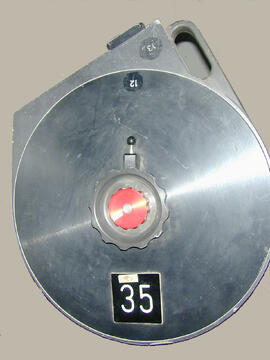
              Wire chamber
              CERN-OBJ-DE-040 · Pièce · 1967
              Fait partie de Heritage Collection Test

              Magnetoscriptive readout wire chamber.Multi-wire detectors contain layers of positively and negatively charged wires enclosed in a chamber full of gas. A charged particle passing through the chamber knocks negatively charged electrons out of atoms in the gas, leaving behind positive ions. The electrons are pulled towards the positively charged wires. They collide with other atoms on the way, producing an avalanche of electrons and ions. The movement of these electrons and ions induces an electric pulse in the wires which is collected by fast electronics. The size of the pulse is proportional to the energy loss of the original particle.

              wire chamber
              CERN-OBJ-DE-048 · Pièce
              Fait partie de Heritage Collection Test

              Multi-wire detectors contain layers of positively and negatively charged wires enclosed in a chamber full of gas. A charged particle passing through the chamber knocks negatively charged electrons out of atoms in the gas, leaving behind positive ions. The electrons are pulled towards the positively charged wires. They collide with other atoms on the way, producing an avalanche of electrons and ions. The movement of these electrons and ions induces an electric pulse in the wires which is collected by fast electronics. The size of the pulse is proportional to the energy loss of the original particle.

              wire chamber
              CERN-OBJ-DE-051 · Pièce · 1985
              Fait partie de Heritage Collection Test

              Multi-wire detectors contain layers of positively and negatively charged wires enclosed in a chamber full of gas. A charged particle passing through the chamber knocks negatively charged electrons out of atoms in the gas, leaving behind positive ions. The electrons are pulled towards the positively charged wires. They collide with other atoms on the way, producing an avalanche of electrons and ions. The movement of these electrons and ions induces an electric pulse in the wires which is collected by fast electronics. The size of the pulse is proportional to the energy loss of the original particle.