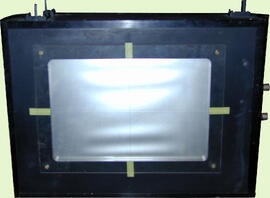
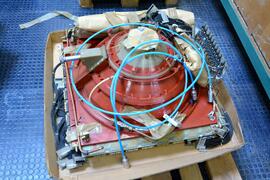
Before the days of electronic detectors, visual techniques were used to detect particles, using detectors such as spark chambers and bubble chambers. This plexiglass lens was used to focus the image of tracks so they could be photographed.
Detector
196 Archival description results for Detector
The 10cm diameter chamber made by Charles Peyrou was the first liquid hydrogen bubble chamber built at CERN.
<3> pieces. Mesures are of the largest one. Multi-wire detectors contain layers of positively and negatively charged wires enclosed in a chamber full of gas. A charged particle passing through the chamber knocks negatively charged electrons out of atoms in the gas, leaving behind positive ions. The electrons are pulled towards the positively charged wires. They collide with other atoms on the way, producing an avalanche of electrons and ions. The movement of these electrons and ions induces an electric pulse in the wires which is collected by fast electronics. The size of the pulse is proportional to the energy loss of the original particle.