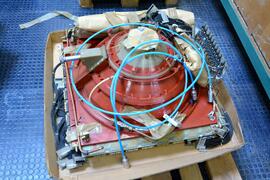
Detector

Área de elementos

Taxonomia

Código

Nota(s) de âmbito

    Nota(s) da fonte

      Mostrar nota(s)

        Termos hierárquicos

        Detector

          Termos equivalentes

          Detector

            Termos associados

            Detector

              261 Descrição arquivística resultados para Detector

              261 resultados diretamente relacionados Excluir termos específicos
              OPAL model
              CERN-OBJ-DE-013 · Item
              Parte de Heritage Collection Test

              Engineering model used for the construction of the OPAL detector at the LEP accelerator.Scale=1/10

              Charpak hemispherical wire chamber
              CERN-OBJ-DE-026 · Item · 1970
              Parte de Heritage Collection Test

              <3> pieces. Mesures are of the largest one. Multi-wire detectors contain layers of positively and negatively charged wires enclosed in a chamber full of gas. A charged particle passing through the chamber knocks negatively charged electrons out of atoms in the gas, leaving behind positive ions. The electrons are pulled towards the positively charged wires. They collide with other atoms on the way, producing an avalanche of electrons and ions. The movement of these electrons and ions induces an electric pulse in the wires which is collected by fast electronics. The size of the pulse is proportional to the energy loss of the original particle.

              PS wire chamber
              CERN-OBJ-DE-028 · Item · 1970
              Parte de Heritage Collection Test

              A wire chamber used at CERN's Proton Synchrotron accelerator in the 1970s. Multi-wire detectors contain layers of positively and negatively charged wires enclosed in a chamber full of gas. A charged particle passing through the chamber knocks negatively charged electrons out of atoms in the gas, leaving behind positive ions. The electrons are pulled towards the positively charged wires. They collide with other atoms on the way, producing an avalanche of electrons and ions. The movement of these electrons and ions induces an electric pulse in the wires which is collected by fast electronics. The size of the pulse is proportional to the energy loss of the original particle.

              Breskin wire chamber
              CERN-OBJ-DE-035 · Item · 1970
              Parte de Heritage Collection Test

              Prototype made by Breskin.Has never been used. Breskin was a ph.d student working under Charpak supervision. The dimensions include the support.

              Sem título
              PS wire chamber
              CERN-OBJ-DE-038 · Item · 1970
              Parte de Heritage Collection Test

              Three pieces. Wire chambers used for the beams at CERN's Proton Synchrotron accelerator in the 1970s. Multi-wire detectors contain layers of positively and negatively charged wires enclosed in a chamber Multi-wire detectors contain layers of positively and negatively charged wires enclosed in a chamber full of gas. A charged particle passing through the chamber knocks negatively charged electrons out of atoms in the gas, leaving behind positive ions. The electrons are pulled towards the positively charged wires. They collide with other atoms on the way, producing an avalanche of electrons and ions. The movement of these electrons and ions induces an electric pulse in the wires which is collected by fast electronics. The size of the pulse is proportional to the energy loss of the original particle.

              Sem título