Detector

Elements area

Taxonomie

Code

Bereik aantekeningen

    ron aantekeningen

      Toon aantekening(en)

        Hiërarchische termen

        Detector

          Gelijksoortige termen

          Detector

            Verwante termen

            Detector

              196 Archivistische beschrijving results for Detector

              196 results directly related Exclude narrower terms
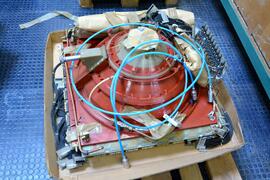
              CERN-OBJ-DE-026 · Stuk · 1970
              Part of Heritage Collection Test

              <3> pieces. Mesures are of the largest one. Multi-wire detectors contain layers of positively and negatively charged wires enclosed in a chamber full of gas. A charged particle passing through the chamber knocks negatively charged electrons out of atoms in the gas, leaving behind positive ions. The electrons are pulled towards the positively charged wires. They collide with other atoms on the way, producing an avalanche of electrons and ions. The movement of these electrons and ions induces an electric pulse in the wires which is collected by fast electronics. The size of the pulse is proportional to the energy loss of the original particle.

              PS wire chamber
              CERN-OBJ-DE-028 · Stuk · 1970
              Part of Heritage Collection Test

              A wire chamber used at CERN's Proton Synchrotron accelerator in the 1970s. Multi-wire detectors contain layers of positively and negatively charged wires enclosed in a chamber full of gas. A charged particle passing through the chamber knocks negatively charged electrons out of atoms in the gas, leaving behind positive ions. The electrons are pulled towards the positively charged wires. They collide with other atoms on the way, producing an avalanche of electrons and ions. The movement of these electrons and ions induces an electric pulse in the wires which is collected by fast electronics. The size of the pulse is proportional to the energy loss of the original particle.

              Breskin wire chamber
              CERN-OBJ-DE-035 · Stuk · 1970
              Part of Heritage Collection Test

              Prototype made by Breskin.Has never been used. Breskin was a ph.d student working under Charpak supervision. The dimensions include the support.

              Zonder titel
              PS wire chamber
              CERN-OBJ-DE-038 · Stuk · 1970
              Part of Heritage Collection Test

              Three pieces. Wire chambers used for the beams at CERN's Proton Synchrotron accelerator in the 1970s. Multi-wire detectors contain layers of positively and negatively charged wires enclosed in a chamber Multi-wire detectors contain layers of positively and negatively charged wires enclosed in a chamber full of gas. A charged particle passing through the chamber knocks negatively charged electrons out of atoms in the gas, leaving behind positive ions. The electrons are pulled towards the positively charged wires. They collide with other atoms on the way, producing an avalanche of electrons and ions. The movement of these electrons and ions induces an electric pulse in the wires which is collected by fast electronics. The size of the pulse is proportional to the energy loss of the original particle.

              Zonder titel
              Wire chamber
              CERN-OBJ-DE-050 · Stuk
              Part of Heritage Collection Test

              Multi-wire detectors contain layers of positively and negatively charged wires enclosed in a chamber full of gas. A charged particle passing through the chamber knocks negatively charged electrons out of atoms in the gas, leaving behind positive ions. The electrons are pulled towards the positively charged wires. They collide with other atoms on the way, producing an avalanche of electrons and ions. The movement of these electrons and ions induces an electric pulse in the wires which is collected by fast electronics. The size of the pulse is proportional to the energy loss of the original particle.

              OPAL Jet Chamber Prototype
              CERN-OBJ-DE-065 · Stuk · 1984-86
              Part of Heritage Collection Test

              OPAL was one of the four experiments installed at the LEP particle accelerator from 1989 - 2000. OPAL's central tracking system consists of (in order of increasing radius) a silicon microvertex detector, a vertex detector, a jet chamber, and z-chambers. All the tracking detectors work by observing the ionization of atoms by charged particles passing by: when the atoms are ionized, electrons are knocked out of their atomic orbitals, and are then able to move freely in the detector. These ionization electrons are detected in the dirfferent parts of the tracking system. This piece is a prototype of the jet chambers

              Zonder titel
              Gargamelle flash tube
              CERN-OBJ-DE-002 · Stuk · 1970
              Part of Heritage Collection Test

              Flash tube used in Gargamelle. Gargamelle was the name given to a big bubble chamber built at the Saclay Laboratory in France during the late 1960s. It was designed principally for the detection at CERN of the elusive particles called neutrinos.Gargamelle is on display at CERN in the Microcosm garden.