Detector

Área de elementos

Taxonomía

Código

Nota(s) sobre el alcance

    Nota(s) sobre el origen

      Mostrar nota(s)

        Términos jerárquicos

        Detector

          Términos equivalentes

          Detector

            Términos asociados

            Detector

              261 Descripción archivística resultados para Detector

              261 resultados directamente relacionados Excluir términos relacionados
              PS wire chamber
              CERN-OBJ-DE-037 · Unidad documental simple · 1970
              Parte de Heritage Collection Test

              A wire chamber used at CERN's Proton Synchrotron accelerator in the 1970s. Multi-wire detectors contain layers of positively and negatively charged wires enclosed in a chamber full of gas. A charged particle passing through the chamber knocks negatively charged electrons out of atoms in the gas, leaving behind positive ions. The electrons are pulled towards the positively charged wires. They collide with other atoms on the way, producing an avalanche of electrons and ions. The movement of these electrons and ions induces an electric pulse in the wires which is collected by fast electronics. The size of the pulse is proportional to the energy loss of the original particle.

              Sin título
              Wire Chamber
              CERN-OBJ-DE-041 · Unidad documental simple
              Parte de Heritage Collection Test

              Magnetoscriptive readout wire chamber. Multi-wire detectors contain layers of positively and negatively charged wires enclosed in a chamber full of gas. A charged particle passing through the chamber knocks negatively charged electrons out of atoms in the gas, leaving behind positive ions. The electrons are pulled towards the positively charged wires. They collide with other atoms on the way, producing an avalanche of electrons and ions. The movement of these electrons and ions induces an electric pulse in the wires which is collected by fast electronics. The size of the pulse is proportional to the energy loss of the original particle.

              CERN-OBJ-DE-042 · Unidad documental simple
              Parte de Heritage Collection Test

              Instrument used to test the wires of small chambers before closing them. The chambers were 50cm long, 0.45cm wide and 0.06cm thick. They were meant to be used in a calorimeter for a PS experiment.

              Sin título
              double counter
              CERN-OBJ-DE-044 · Unidad documental simple · 1970
              Parte de Heritage Collection Test

              A double counter made of a scintillation counter with 8 photomultiplier tubes and a cherenkov counter. Was used to identify particles.The dimensions include the support.

              Sin título
              DELPHI Silicon Tracker
              CERN-OBJ-DE-052 · Unidad documental simple
              Parte de Heritage Collection Test

              DELPHI was one of the four experiments installed at the LEP particle accelerator from 1989 - 2000. The silicon tracking detector was nearest to the collision point in the centre of the detector. It was used to pinpoint the collision and catch short-lived particles.

              CERN-OBJ-DE-056 · Unidad documental simple
              Parte de Heritage Collection Test

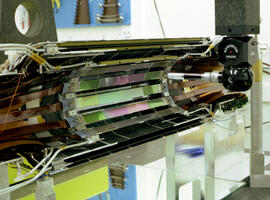
              OPAL was one of the four experiments installed at the LEP particle accelerator from 1989 - 2000. OPAL's central tracking system consists of (in order of increasing radius) a silicon microvertex detector, a vertex detector, a jet chamber, and z-chambers. All the tracking detectors work by observing the ionization of atoms by charged particles passing by: when the atoms are ionized, electrons are knocked out of their atomic orbitals, and are then able to move freely in the detector. These ionization electrons are detected in the different parts of the tracking system. (This piece includes the vertex, jet and Z chambers) In the picture above, the central detector is the piece being removed to the right.

              CMS Tracker Model
              CERN-OBJ-DE-068 · Unidad documental simple
              Parte de Heritage Collection Test

              Model of the tracking detector for the CMS experiment at the LHC. This object is a mock-up of an early design of the CMS Tracker mechanics. It is a segment of a “Wheel” to support Micro-Strip Gas Chamber (MSGC) detector modules on the outer layers and silicon-strip detector modules in the innermost layers. The particularity of that design is that modules are organised in spirals, along which power and optical cables and cooling pipes were planned to be routed. Some of such spirals are illustrated in the mock-up by the colors of the modules. With the detector development it became, however, evident that the silicon detectors would need to be operated in LHC experiments in cold temperatures, while the MSGC could stay in normal room-temperature. That split in two temperatures lead to separating those two detector types by a thermal barrier and therefore jeopardizing the idea of using common, vertical Wheels with services arranged along spirals.

              Sin título
              lens
              CERN-OBJ-DE-006 · Unidad documental simple
              Parte de Heritage Collection

              RCVD lens n°4

              Sin título
              light guide
              CERN-OBJ-DE-007 · Unidad documental simple
              Parte de Heritage Collection

              A full box of small light guides A full box of small light guides.Light guides like this are used to carry signals to the electronics for recording.