Computing and computers

Área de elementos

Taxonomia

Código

Nota(s) de âmbito

    Nota(s) da fonte

      Mostrar nota(s)

        Termos hierárquicos

        Computing and computers

          Termos equivalentes

          Computing and computers

            Termos associados

            Computing and computers

              260 Descrição arquivística resultados para Computing and computers

              260 resultados diretamente relacionados Excluir termos específicos
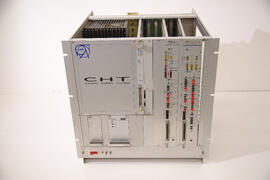
              CHT, CERN HIPPI Testbox
              CERN-OBJ-IT-116 · Item · 1990
              Parte de Heritage Collection

              To allow CERN to test and maintain HIPPI equipment (High Performance Parallel Interface), a powerful test falcility is required. A tester has been developed at Los Alamos National Laboratories [9,10]. The CERN HIPPI testbox allows testing of HIPPI equipment both inside and outside the specifications. This includes the possibility of deliberately introducing errors. The main features of this testbox are: Manual set-up Processor controlled set-up Possibilities for remote analysis Checking the HIPPI specifications Checking illegal conditions

              IBM 5150 computer
              CERN-OBJ-IT-118 · Item · 1981
              Parte de Heritage Collection

              IBM’s first personal computer arrived nearly 10 years after others companies, but instantly legitimized the market. IBM introduced its PC in 1981. IBM equipped the model 5150 with a cassette port for connecting a cassette drive. The first IBM PC ran on a 4.77 MHz Intel 8088 microprocessor. The PC came equipped with 16 kilobytes of memory, expandable to 256k. The PC came with one or two 160k floppy disk drives and an optional color monitor. The price tag started at $1,565, which would be nearly $4,000 (about €3,400) today.

              8-inch IBM floppy disk
              CERN-OBJ-IT-037 · Item · 1971
              Parte de Heritage Collection Test

              The 8-inch floppy disk was a magnetic storage disk for the data introduced commercially by IBM in 1971. It was designed by an IBM team as an inexpensive way to load data into the IBM System / 370. Plus it was a read-only bare disk containing 80 KB of data. The first read-write version was introduced in 1972 by Memorex and could contain 175 KB on 50 tracks (with 8 sectors per track). Other improvements have led to various coatings and increased capacities. Finally, it was surpassed by the mini diskette of 5.25 inches introduced in 1976.

              StorageTek RedWood SD-3 tape drive
              CERN-OBJ-IT-041 · Item · 1995
              Parte de Heritage Collection Test

              A helical scan recording drive, with a high-speed rotating head sweeping across the tape every few micrometers. Based on a professional video recording system, modified to be suitable for digital data recording. These are commonly used with large computer systems, typically in conjunction with a robotic tape library.

              6250 BPI Magnetic Tape
              CERN-OBJ-IT-044 · Item
              Parte de Heritage Collection Test

              These are magnetic coil bands designed by IBM with 6250 BPI. BPI means bits per inch and specifies the data density a magnetic coil can hold.

              CERNET High Speed Data Link
              CERN-OBJ-IT-049 · Item · 1975
              Parte de Heritage Collection Test

              This card, based on a "4 slot DEC module", arbitrated the access priority of 15 datalinks of a CERNET node. Each datalinks could transfer data full duplex at 2.5 Mbit/sec over 1 Km of twisted pair (POD) cable. This was the frontier technology in 1980. The modest amount of integrated circuits was compensated by printing on the board photographs of the hardware designers, whose Belgian, Dutch and French nationality was underlined by the the short poem.