Computing and computers

Área de elementos

Taxonomía

Código

Nota(s) sobre el alcance

    Nota(s) sobre el origen

      Mostrar nota(s)

        Términos jerárquicos

        Computing and computers

          Términos equivalentes

          Computing and computers

            Términos asociados

            Computing and computers

              129 Descripción archivística resultados para Computing and computers

              129 resultados directamente relacionados Excluir términos relacionados
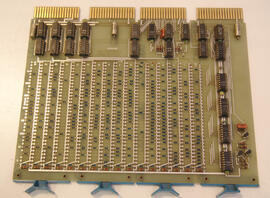
              A Diode Matrix model M792
              Heritage collection CERN-OBJ-CERN-OBJ-IT-095 · Unidad documental simple
              Parte de Heritage Collection Test

              A diode matrix is an extremely low-density form of read-only memory. It's one of the earliest forms of ROMs (dating back to the 1950s). Each bit in the ROM is represented by the presence or absence of one diode. The ROM is easily user-writable using a soldering iron and pair of wire cutters.This diode matrix board is a floppy disk boot ROM for a PDP-11, and consists of 32 16-bit words. When you access an address on the ROM, the circuit returns the represented data from that address.
              6250 BPI IBM reduce version 3.3
              Heritage collection CERN-OBJ-CERN-OBJ-IT-098 · Unidad documental simple · 1988
              Parte de Heritage Collection Test

              These are magnetic coil bands designed by IBM with 6250 BPI. BPI means bits per inch and specifies the data density a magnetic coil can hold.

              Seagate ST-225 Hard Drive
              Heritage collection CERN-OBJ-CERN-OBJ-IT-103 · Unidad documental simple · 1984
              Parte de Heritage Collection Test

              This hard drive was developed by Seagate in 1984, and had a capacity of 20 MB. It was the single most common 20MB drive ever to be produced.

              Weston Standard battery
              Heritage collection CERN-OBJ-CERN-OBJ-IT-113 · Unidad documental simple
              Parte de Heritage Collection Test

              This is a Weston AOIP standard battery with its calibration certificate (1956). Inside, the glassware forms an "H". Its name comes from the British physicist Edward Weston. A standard is the materialization of a given quantity whose value is known with great accuracy.

              PM 3655 PHILIPS Logic analyzer
              Heritage collection CERN-OBJ-CERN-OBJ-IT-114 · Unidad documental simple
              Parte de Heritage Collection Test

              A logic analyzer is an electronic instrument that captures and displays multiple signals from a digital system or digital circuit. A logic analyzer may convert the captured data into timing diagrams, protocol decodes, state machine traces, assembly language, or may correlate assembly with source-level software. Logic Analyzers have advanced triggering capabilities, and are useful when a user needs to see the timing relationships between many signals in a digital system.