CERN-OBJ-IT-107
·
Item
·
1964
Part of Heritage Collection Test
Computing and computers
260 Archival description results for Computing and computers
260 results directly related
Exclude narrower terms

CERN-OBJ-IT-107
·
Item
·
1964
Part of Heritage Collection

CERN-OBJ-IT-023
·
Item
·
1970
Part of Heritage Collection
The CDC 7600 has been created by Seymour Cray. It was designed to be compatible with the 6600, which allows for a substantial increase in performance. Furthermore the rise of new technologies has enabled this performance by reducing the minor cycle clock period from 100 ns to 27.5 ns (4 time faster). A very large machine, the 7600 had over 120 miles of hand-wired interconnections. It was the most powerful computer of its time. However, this speed caused a ground-loop problem causing intermittent faults, and eventually requiring all modules to be fitted with sheathed rubber bands. The CDC 7600 was replaced in 1983 by CRAY-1A.
CERN-OBJ-IT-023
·
Item
·
1970
Part of Heritage Collection Test
The CDC 7600 has been created by Seymour Cray. It was designed to be compatible with the 6600, which allows for a substantial increase in performance. Furthermore the rise of new technologies has enabled this performance by reducing the minor cycle clock period from 100 ns to 27.5 ns (4 time faster). A very large machine, the 7600 had over 120 miles of hand-wired interconnections. It was the most powerful computer of its time. However, this speed caused a ground-loop problem causing intermittent faults, and eventually requiring all modules to be fitted with sheathed rubber bands. The CDC 7600 was replaced in 1983 by CRAY-1A.
CERN-OBJ-IT-082
·
Item
Part of Heritage Collection
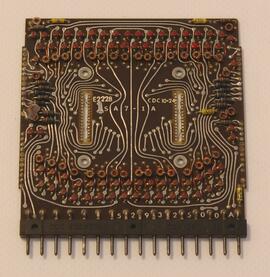
Each module contained 8 circuit cards for a total of about 300-500 uncovered transistors packaged with face plates so the Freon plates wouldn't touch the circuits. (cooling plates that surrounded each module).
CERN-OBJ-IT-082
·
Item
Part of Heritage Collection Test
Each module contained 8 circuit cards for a total of about 300-500 uncovered transistors packaged with face plates so the Freon plates wouldn't touch the circuits. (cooling plates that surrounded each module).

CERN-OBJ-IT-062
·
Item
·
1960-1969
Part of Heritage Collection
CERN-OBJ-IT-062
·
Item
·
1960-1969
Part of Heritage Collection Test
CERN-OBJ-IT-089
·
Item
·
1965-1970
Part of Heritage Collection
CERN-OBJ-IT-089
·
Item
·
1965-1970
Part of Heritage Collection Test