System 7 is a single-user graphical user interface-based operating system for Macintosh computers and was part of the classic Mac OS line of operating systems. It was introduced on May 13, 1991, by Apple Computer. It succeeded System 6, and was the main Macintosh operating system until it was succeeded by Mac OS 8 in 1997. Features added with the System 7 release included virtual memory, personal file sharing, QuickTime, QuickDraw 3D, and an improved user interface. This is the first real major evolution of the Macintosh system, bringing a significant improvement in the user interface, improved stability and many new features such as the ability to use multiple applications at the same time. "System 7" is the last operating system name of the Macintosh that contains the word "system". Macintosh operating systems were later called "Mac OS" (for Macintosh Operating System).
Computing and computers
260 Archival description results for Computing and computers
260 results directly related
Exclude narrower terms
CERN-OBJ-IT-108
·
Item
·
1991
Part of Heritage Collection Test
CERN-OBJ-IT-043
·
Item
·
1998
Part of Heritage Collection Test
The Sun Ultra 5 is a 64-bit personal computer based on the UltraSPARC microprocessor line at a low price. The Ultra 5 has been declined in several variants: thus, some models have a processor with less cache memory to further decrease the price of the computer.

CERN-OBJ-IT-043
·
Item
·
1998
Part of Heritage Collection
The Sun Ultra 5 is a 64-bit personal computer based on the UltraSPARC microprocessor line at a low price. The Ultra 5 has been declined in several variants: thus, some models have a processor with less cache memory to further decrease the price of the computer.

CERN-OBJ-IT-054
·
Item
·
2002
Part of Heritage Collection
Technology allowed reuse of the same data cartridge at higher capacity with later model of the tape drive hence offering significant savings of the media cost. It has been use by the CERN from 2002 to 2008.
CERN-OBJ-IT-054
·
Item
·
2002
Part of Heritage Collection Test
Technology allowed reuse of the same data cartridge at higher capacity with later model of the tape drive hence offering significant savings of the media cost. It has been use by the CERN from 2002 to 2008.
CERN-OBJ-IT-137
·
Item
Part of Heritage Collection Test
The cartridges had a total capacity of up to 8.5 TB. They were actually manufactured by the Fujifilm company, used Barium Ferrite (BaFe) magnetic particle technology to store the user data and were equipped with a Radio-Frequency IDentification (RFID) chip (for quick access to the cartridge metadata).\ The tape length inside of each cartridge is 1147 meters while it is only 5.2 microns thick. Once mounted in a tape drive, the media moves over the drive head at the speeds of up to 4.7 meters/second when reading or writing, but up to 13 meters/second when locating to a file. Since 2019, all data that had been stored on such cartridges have been copied onto more modern supports. As of 2022, CERN uses similar tapes produced by other suppliers and having a capacity of up to 20 TB.

CERN-OBJ-IT-137
·
Item
Part of Heritage Collection
The cartridges had a total capacity of up to 8.5 TB. They were actually manufactured by the Fujifilm company, used Barium Ferrite (BaFe) magnetic particle technology to store the user data and were equipped with a Radio-Frequency IDentification (RFID) chip (for quick access to the cartridge metadata).\ The tape length inside of each cartridge is 1147 meters while it is only 5.2 microns thick. Once mounted in a tape drive, the media moves over the drive head at the speeds of up to 4.7 meters/second when reading or writing, but up to 13 meters/second when locating to a file. Since 2019, all data that had been stored on such cartridges have been copied onto more modern supports. As of 2022, CERN uses similar tapes produced by other suppliers and having a capacity of up to 20 TB.

CERN-OBJ-IT-011
·
Item
·
1985
Part of Heritage Collection Test
Oracle StorageTek T10000T2 cartridge has total capacity of 5 TB. It is actually manufactured by Fuji Film, uses Barium Ferrite (BaFe) particles technology data store, but is also equipped with RFID chip. There is over 1 km of tape inside of the cartridge with 3584 data tracks and it supports over 25000 load/unload cycles. The archival life is estimated to be around 30 years and uncorrected bit error rate is 10-19. CERN however usually migrates data to newer technologies roughly every 5 years in order to keep the footprint under control.
CERN-OBJ-IT-011
·
Item
·
1985
Part of Heritage Collection
Oracle StorageTek T10000T2 cartridge has total capacity of 5 TB. It is actually manufactured by Fuji Film, uses Barium Ferrite (BaFe) particles technology data store, but is also equipped with RFID chip. There is over 1 km of tape inside of the cartridge with 3584 data tracks and it supports over 25000 load/unload cycles. The archival life is estimated to be around 30 years and uncorrected bit error rate is 10-19. CERN however usually migrates data to newer technologies roughly every 5 years in order to keep the footprint under control.
CERN-OBJ-IT-053
·
Item
Part of Heritage Collection
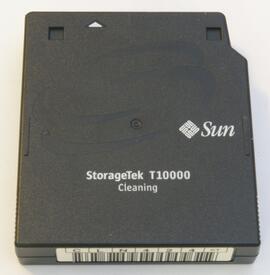
This data cartridge works on several StorageTek systems. The goal is to provide cartridge compatibility across several system. It has been designed for space saving and ultra-high capacity tape. It permit to fulfill high-volume backup, archiving, and disaster recovery.